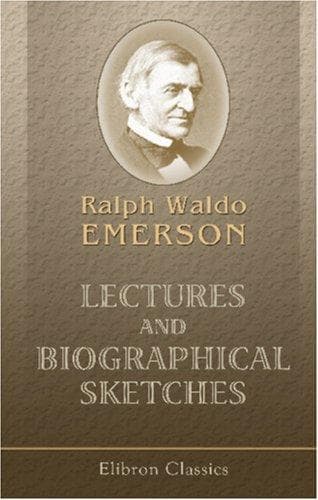
Lectures and biographical sketchesEmerson, Ralph Waldo
Philosophy
Lectures and biographical sketches
Emerson, Ralph Waldo
American essays -- 19th century; Speeches, addresses, etc., American -- 19th century
IN the month of November, 1840, a Convention of Friends of Universal
Reform assembled in the Chardon Street Chapel in Boston, in obedience
to a call in the newspapers, signed by a few individuals, inviting all
persons to a public discussion of the institutions of the Sabbath,
the Church and the Ministry. The Convention organized itself by
the choice of Edmund Quincy as Moderator, spent three days in the
consideration of the Sabbath, and adjourned to a day in March of the
following year, for the discussion of the second topic. In March,
accordingly, a three-days’ sessions was holden in the same place, on
the subject of the Church, and a third meeting fixed for the following
November, which was accordingly holden; and the Convention debated,
for three days again, the remaining subject of the Priesthood. This
Convention never printed any report of its deliberations, nor pretended
to arrive at any result by the expression of its sense in formal
resolutions;--the professed objects of those persons who felt the
greatest interest in its meetings being simply the elucidation of
truth through free discussion. The daily newspapers reported, at the
time, brief sketches of the course of proceedings, and the remarks
of the principal speakers. These meetings attracted a great deal of
public attention, and were spoken of in different circles in every
note of hope, of sympathy, of joy, of alarm, of abhorrence and of
merriment. The composition of the assembly was rich and various. The
singularity and latitude of the summons drew together, from all parts
of New England and also from the Middle States, men of every shade of
opinion from the straitest orthodoxy to the wildest heresy, and many
persons whose church was a church of one member only. A great variety
of dialect and of costume was noticed; a great deal of confusion,
eccentricity, and freak appeared, as well as of zeal and enthusiasm.
If the assembly was disorderly, it was picturesque. Madmen, madwomen,
men with beards, Dunkers, Muggletonians, Come-outers, Groaners,
Agrarians, Seventh-day-Baptists, Quakers, Abolitionists, Calvinists,
Unitarians and Philosophers,--all came successively to the top, and
seized their moment, if not their hour, wherein to chide, or pray, or
preach, or protest. The faces were a study. The most daring innovators
and the champions-until-death of the old cause sat side by side. The
still-living merit of the oldest New England families, glowing yet
after several generations, encountered the founders of families,
fresh merit, emerging, and expanding the brows to a new breadth,
and lighting a clownish face with sacred fire. The assembly was
characterized by the predominance of a certain plain, sylvan strength
and earnestness, whilst many of the most intellectual and cultivated
persons attended its councils. Dr. Channing, Edward Taylor, Bronson
Alcott, Mr. Garrison, Mr. May, Theodore Parker, H. C. Wright, Dr.
Osgood, William Adams, Edward Palmer, Jones Very, Maria W. Chapman, and
Public-domain text, read in full here on John Shaqi.
Reviews
Reviews
No reviews yet
Be the first to share your thoughts on this work.
Elsewhere in the archive
Join the Discussion
Join the discussion
Sign in to leave a comment or review.
Sign InorCreate an account