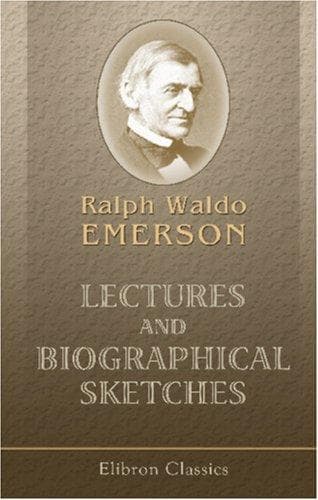
Lectures and biographical sketchesEmerson, Ralph Waldo
Philosophy
Lectures and biographical sketches
Emerson, Ralph Waldo
American essays -- 19th century; Speeches, addresses, etc., American -- 19th century
He used to tell the story of one of his old friends, the minister
of Sudbury, who, being at the Thursday lecture in Boston, heard the
officiating clergyman praying for rain. As soon as the service was
over, he went to the petitioner, and said, “You Boston ministers, as
soon as a tulip wilts under your windows, go to church and pray for
rain, until all Concord and Sudbury are under water.” I once rode with
him to a house at Nine Acre Corner to attend the funeral of the father
of a family. He mentioned to me on the way his fears that the oldest
son, who was now to succeed to the farm, was becoming intemperate.
We presently arrived, and the Doctor addressed each of the mourners
separately: “Sir, I condole with you.” “Madam, I condole with you.”
“Sir, I knew your great-grandfather. When I came to this town, your
great-grandfather was a substantial farmer in this very place, a member
of the church, and an excellent citizen. Your grandfather followed him,
and was a virtuous man. Now your father is to be carried to his grave,
full of labors and virtues. There is none of that large family left but
you, and it rests with you to bear up the good name and usefulness of
your ancestors. If you fail, Ichabod, the glory is departed. Let us
pray.” Right manly he was, and the manly thing he could always say. I
can remember a little speech he made to me, when the last tie of blood
which held me and my brothers to his house was broken by the death of
his daughter. He said, on parting, “I wish you and your brothers to
come to this house as you have always done. You will not like to be
excluded; I shall not like to be neglected.”
When “Put” Merriam, after his release from the state prison, had the
effrontery to call on the doctor as an old acquaintance, in the midst
of general conversation Mr. Frost came in, and the doctor presently
said, “Mr. Merriam, my brother and colleague, Mr. Frost, has come to
take tea with me. I regret very much the causes (which you know very
well) which make it impossible for me to ask you to stay and break
bread with us.” With the Doctor’s views it was a matter of religion to
say thus much. He had a reverence and love of society, and the patient,
continuing courtesy, carrying out every respectful attention to the
end, which marks what is called the manners of the old school. His
hospitality obeyed Charles Lamb’s rule, and “ran fine to the last.” His
partiality for ladies was always strong, and was by no means abated by
time. He claimed privilege of years, was much addicted to kissing;
spared neither maid, wife, nor widow, and, as a lady thus favored
remarked to me, “seemed as if he was going to make a meal of you.”
Public-domain text, read in full here on John Shaqi.
Reviews
Reviews
No reviews yet
Be the first to share your thoughts on this work.
Elsewhere in the archive
Join the Discussion
Join the discussion
Sign in to leave a comment or review.
Sign InorCreate an account