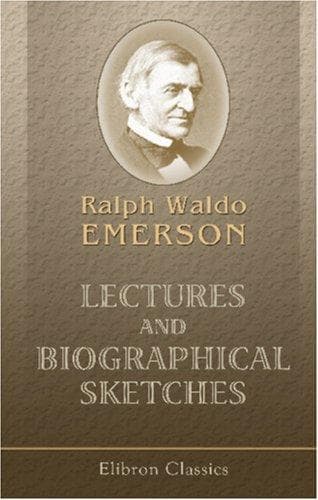
Lectures and biographical sketchesEmerson, Ralph Waldo
Philosophy
Lectures and biographical sketches
Emerson, Ralph Waldo
American essays -- 19th century; Speeches, addresses, etc., American -- 19th century
He showed even in his fireside discourse traits of that pertinency
and judgment, softening ever and anon into elegancy, which make the
distinction of the scholar, and which, under better discipline, might
have ripened into a Bentley or a Porson. He had a foresight, when he
opened his mouth, of all that he would say, and he marched straight to
the conclusion. In debate in the vestry of the Lyceum, the structure of
his sentences was admirable; so neat, so natural, so terse, his words
fell like stones; and often, though quite unconscious of it, his speech
was a satire on the loose, voluminous, draggle-tail periods of other
speakers. He sat down when he had done. A man of anecdote, his talk in
the parlor was chiefly narrative. We remember the remark of a gentleman
who listened with much delight to his conversation at the time when the
Doctor was preparing to go to Baltimore and Washington, that “a man who
could tell a story so well was company for kings and John Quincy Adams.”
Sage and savage strove harder in him than in any of my acquaintances,
each getting the mastery by turns, and pretty sudden turns: “Save
us from the extremity of cold and these violent sudden changes.”
“The society will meet after the Lyceum, as it is difficult to bring
people together in the evening,--and no moon.” “Mr. N. F. is dead, and
I expect to hear of the death of Mr. B. It is cruel to separate old
people from their wives in this cold weather.”
With a very limited acquaintance with books, his knowledge was an
external experience, an Indian wisdom, the observation of such facts
as country life for nearly a century could supply. He watched with
interest the garden, the field, the orchard, the house and the barn,
horse, cow, sheep and dog, and all the common objects that engage
the thought of the farmer. He kept his eye on the horizon, and knew
the weather like a sea-captain. The usual experiences of men, birth,
marriage, sickness, death, burial; the common temptations; the common
ambitions;--he studied them all, and sympathized so well in these that
he was excellent company and counsel to all, even the most humble and
ignorant. With extraordinary states of mind, with states of enthusiasm
or enlarged speculation, he had no sympathy, and pretended to none.
He was sincere, and kept to his point, and his mark was never remote.
His conversation was strictly personal and apt to the party and the
occasion. An eminent skill he had in saying difficult and unspeakable
things; in delivering to a man or a woman that which all their other
friends had abstained from saying, in uncovering the bandage from a
sore place, and applying the surgeon’s knife with a truly surgical
spirit. Was a man a sot, or a spendthrift, or too long time a bachelor,
or suspected of some hidden crime, or had he quarrelled with his
wife, or collared his father, or was there any cloud or suspicious
circumstances in his behavior, the good pastor knew his way straight
Public-domain text, read in full here on John Shaqi.
Reviews
Reviews
No reviews yet
Be the first to share your thoughts on this work.
Elsewhere in the archive
Join the Discussion
Join the discussion
Sign in to leave a comment or review.
Sign InorCreate an account