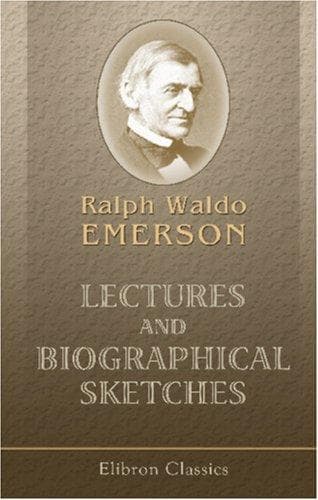
Lectures and biographical sketchesEmerson, Ralph Waldo
Philosophy
Lectures and biographical sketches
Emerson, Ralph Waldo
American essays -- 19th century; Speeches, addresses, etc., American -- 19th century
“1826, July. If one could choose, and without crime be gibbeted,--were
it not altogether better than the long drooping away by age without
mentality or devotion? The vulture and crow would _caw caw_,
and, unconscious of any deformity in the mutilated body, would relish
their meal, make no grimace of affected sympathy, nor suffer any
real compassion. I pray to die, though happier myriads and mine own
companions press nearer to the throne. His coldest beam will purify
and render me forever holy. Had I the highest place of acquisition
and diffusing virtue here, the principle of human sympathy would be
too strong for that rapt emotion, that severe delight which I crave;
nay for that kind of obscure virtue which is so rich to lay at the
feet of the Author of morality. Those economists (Adam Smith) who say
nothing is added to the wealth of a nation but what is dug out of the
earth, and that, whatever disposition of virtue may exist, unless
something is done for society, deserves no fame,--why I am content with
such paradoxical kind of facts; but one secret sentiment of virtue,
disinterested (or perhaps not), is worthy, and will tell, in the world
of spirits, of God’s immediate presence, more than the blood of many a
martyr who has it not.” “I have heard that the greatest geniuses have
died ignorant of their power and influence on the arts and sciences. I
believe thus much, that their large perception consumed their egotism,
or made it impossible for them to make small calculations.”
“That greatest of all gifts, however small my power of receiving,--the
capacity, the element to love the All-perfect, without regard to
personal happiness:--happiness?--’tis itself.” She checks herself
amid her passionate prayers for immediate communion with God;--“I who
never made a sacrifice to record,--I cowering in the nest of quiet
for so many years;--I indulge the delight of sympathizing with great
virtues,--blessing their Original: Have I this right?” “While I am
sympathizing in the government of God over the world, perhaps I lose
nearer views. Well, I learned his existence _a priori_. No object
of science or observation ever was pointed out to me by my poor aunt,
but His Being and commands; and oh how much I trusted Him with every
event till I learned the order of human events from the pressure of
wants.”
“What a timid, ungrateful creature! Fear the deepest pit-falls of
age, when pressing on, in imagination at least, to Him with whom a
day is a thousand years,--with whom all miseries and irregularities
are conforming to universal good! Shame on me who have learned within
three years to sit whole days in peace and enjoyment without the least
apparent benefit to any, or knowledge to myself;--resigned, too, to
the memory of long years of slavery passed in labor and ignorance, to
the loss of that character which I once thought and felt so sure of,
without ever being conscious of acting from calculation.”
Public-domain text, read in full here on John Shaqi.
Reviews
Reviews
No reviews yet
Be the first to share your thoughts on this work.
Elsewhere in the archive
Join the Discussion
Join the discussion
Sign in to leave a comment or review.
Sign InorCreate an account