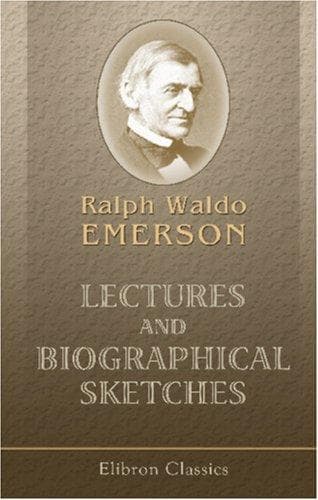
Lectures and biographical sketchesEmerson, Ralph Waldo
Philosophy
Lectures and biographical sketches
Emerson, Ralph Waldo
American essays -- 19th century; Speeches, addresses, etc., American -- 19th century
He lived for the day, not cumbered and mortified by his memory. If he
brought you yesterday a new proposition, he would bring you to-day
another not less revolutionary. A very industrious man, and setting,
like all highly organized men, a high value on his time, he seemed
the only man of leisure in town, always ready for any excursion that
promised well, or for conversation prolonged into late hours. His
trenchant sense was never stopped by his rules of daily prudence, but
was always up to the new occasion. He liked and used the simplest food,
yet, when some one urged a vegetable diet, Thoreau thought all diets a
very small matter, saying that “the man who shoots the buffalo lives
better than the man who boards at the Graham House.” He said,--“You
can sleep near the railroad, and never be disturbed: Nature knows very
well what sounds are worth attending to, and has made up her mind not
to hear the railroad-whistle. But things respect the devout mind, and a
mental ecstasy was never interrupted.” He noted what repeatedly befell
him, that, after receiving from a distance a rare plant, he would
presently find the same in his own haunts. And those pieces of luck
which happen only to good players happened to him. One day, walking
with a stranger, who inquired where Indian arrow-heads could be found,
he replied, “Everywhere,” and, stooping forward, picked one on the
instant from the ground. At Mount Washington, in Tuckerman’s Ravine,
Thoreau had a bad fall, and sprained his foot. As he was in the act of
getting up from his fall, he saw for the first time the leaves of the
_Arnica mollis_.
His robust common sense, armed with stout hands, keen perceptions and
strong will, cannot yet account for the superiority which shone in
his simple and hidden life. I must add the cardinal fact, that there
was an excellent wisdom in him, proper to a rare class of men, which
showed him the material world as a means and symbol. This discovery,
which sometimes yields to poets a certain casual and interrupted light,
serving for the ornament of their writing, was in him an unsleeping
insight; and whatever faults or obstructions of temperament might
cloud it, he was not disobedient to the heavenly vision. In his youth,
he said, one day, “The other world is all my art; my pencils will
draw no other; my jack-knife will cut nothing else; I do not use it
as a means.” This was the muse and genius that ruled his opinions,
conversation, studies, work and course of life. This made him a
searching judge of men. At first glance he measured his companion,
and, though insensible to some fine traits of culture, could very well
report his weight and calibre. And this made the impression of genius
which his conversation sometimes gave.
Public-domain text, read in full here on John Shaqi.
Reviews
Reviews
No reviews yet
Be the first to share your thoughts on this work.
Elsewhere in the archive
Join the Discussion
Join the discussion
Sign in to leave a comment or review.
Sign InorCreate an account