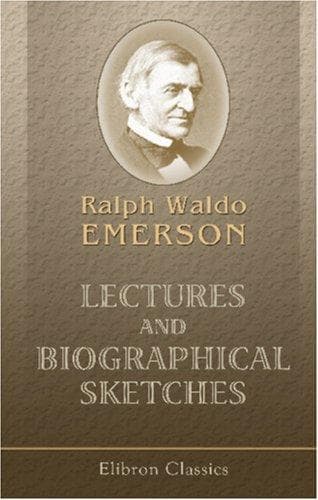
Lectures and biographical sketchesEmerson, Ralph Waldo
Philosophy
Lectures and biographical sketches
Emerson, Ralph Waldo
American essays -- 19th century; Speeches, addresses, etc., American -- 19th century
His poetry might be bad or good; he no doubt wanted a lyric facility
and technical skill, but he had the source of poetry in his spiritual
perception. He was a good reader and critic, and his judgment on poetry
was to the ground of it. He could not be deceived as to the presence or
absence of the poetic element in any composition, and his thirst for
this made him negligent and perhaps scornful of superficial graces. He
would pass by many delicate rhythms, but he would have detected every
live stanza or line in a volume, and knew very well where to find
an equal poetic charm in prose. He was so enamored of the spiritual
beauty that he held all actual written poems in very light esteem in
the comparison. He admired Æschylus and Pindar; but, when someone was
commending them, he said that Æschylus and the Greeks, in describing
Apollo and Orpheus, had given no song, or no good one. “They ought not
to have moved trees, but to have chanted to the gods such a hymn as
would have sung all their old ideas out of their heads, and new ones
in.” His own verses are often rude and defective. The gold does not
yet run pure, is drossy and crude. The thyme and marjoram are not yet
honey. But if he want lyric fineness and technical merits, if he have
not the poetic temperament, he never lacks the causal thought, showing
that his genius was better than his talent. He knew the worth of the
Imagination for the uplifting and consolation of human life, and liked
to throw every thought into a symbol. The fact you tell is of no value,
but only the impression. For this reason his presence was poetic,
always piqued the curiosity to know more deeply the secrets of his
mind. He had many reserves, an unwillingness to exhibit to profane eyes
what was still sacred in his own, and knew well how to throw a poetic
veil over his experience. All readers of “Walden” will remember his
mythical record of his disappointments:--
“I long ago lost a hound, a bay horse and a turtle-dove, and am still
on their trail. Many are the travellers I have spoken concerning them,
describing their tracks, and what calls they answered to. I have met
one or two who have heard the hound, and the tramp of the horse, and
even seen the dove disappear behind a cloud; and they seemed as anxious
to recover them as if they had lost them themselves.”[16]
His riddles were worth the reading, and I confide that if at any time I
do not understand the expression, it is yet just. Such was the wealth
of his truth that it was not worth his while to use words in vain.
His poem entitled “Sympathy” reveals the tenderness under that triple
steel of stoicism, and the intellectual subtility it could animate.
His classic poem on “Smoke” suggests Simonides, but is better than any
poem of Simonides. His biography is in his verses. His habitual thought
makes all his poetry a hymn to the Cause of causes, the Spirit which
vivifies and controls his own:--
Public-domain text, read in full here on John Shaqi.
Reviews
Reviews
No reviews yet
Be the first to share your thoughts on this work.
Elsewhere in the archive
Join the Discussion
Join the discussion
Sign in to leave a comment or review.
Sign InorCreate an account