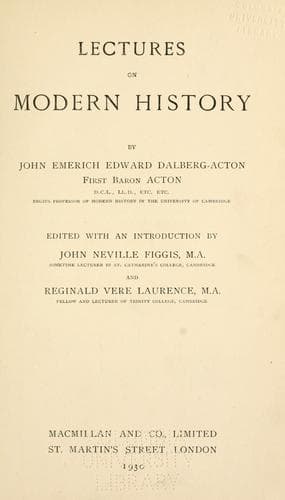
Lectures on Modern historyActon, John Emerich Edward Dalberg Acton, Baron
History
Lectures on Modern history
Acton, John Emerich Edward Dalberg Acton, Baron
History, Modern
not have made so many mistakes if they had attended to the Jewish
commentators.
At that time persecution was raging against the Jews in the Peninsula.
They had always had enemies in the German towns, and in July 1510,
thirty-eight Jews were executed at Berlin. This intolerant spirit
began, in 1507, to be directed against their books. None were printed
in Germany until 1516; but from 1480 they had Hebrew presses in Italy,
at Naples, Mantua, Soncino, and at Constantinople. If their study was
encouraged while the printing was permitted, the Jews would become a
power such as they never were before printing began, and when none but
a few divines could read Hebrew. The movement in favour of destroying
them had its home at Cologne, with Hochstraten, the Inquisitor;
Gratius, a good scholar, whose work, known as Brown's Fasciculus, is
in the hands of every medieval student; and Pfefferkorn, who had the
zeal of a recently converted Jew. In his anxiety to bring over his
former brethren he desired to deprive them of their books. He would
allow them to retain only the Old Testament, without their
commentaries. He would compel them to hear Christian sermons. By
degrees he urged that they should be expelled, and at last that they
should be exterminated.
Maximilian, the emperor, turned with every wind. Reuchlin, the
defender of toleration, was attacked by Pfefferkorn, as a sceptic and
a traitor, and was accused before the ecclesiastical court. In 1514
the Bishop of Spires, acting for the Pope, acquitted Reuchlin; the
sentence was confirmed at Rome in 1516, and the Dominicans, who were
plaintiffs, agreed to pay the costs. Nevertheless they appealed, and
in 1520 Rome reversed the previous judgment and condemned Reuchlin.
In the midst of greater things the sentence escaped attention, and was
only brought to light by a scholar who is still living. But in the
meantime the Humanists had taken up the cause of Reuchlin, and the
result had been disastrous for the Dominicans. They had not directly
assailed the new learning, but their attack on the study of Hebrew had
been the most crass exhibition of retrograde spirit. If Jews were not
allowed to read Jewish books, such as Maimonides, to whom St. Thomas
owes so much, how could Christians be allowed to read pagan classics,
with their highly immoral gods and goddesses?
Public-domain text, read in full here on John Shaqi.
Reviews
Reviews
No reviews yet
Be the first to share your thoughts on this work.
Elsewhere in the archive
Join the Discussion
Join the discussion
Sign in to leave a comment or review.
Sign InorCreate an account