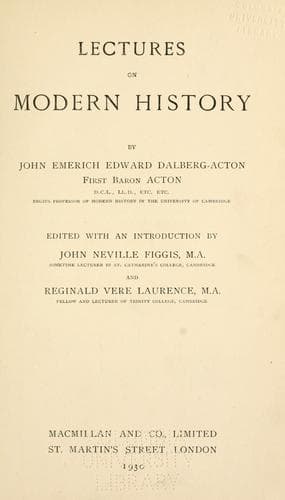
Lectures on Modern historyActon, John Emerich Edward Dalberg Acton, Baron
History
Lectures on Modern history
Acton, John Emerich Edward Dalberg Acton, Baron
History, Modern
further progress of the Lutherans, and it was against this restriction
that certain princes and fourteen towns made the protest from which
Protestantism has its name.
In the following year Melanchthon drew up the Confession of Faith for
the Diet of Augsburg, while Luther remained behind at the castle of
Coburg; his purpose was to explain the essential meaning of
Lutheranism, the consecutive order and connection of ideas, so as to
exclude the Zwinglians and the Anabaptists, and to reconcile the
Catholics. He came to an understanding with the Emperor's secretary,
and Stadion, the Bishop of Augsburg, judged that his proposals were
acceptable, and thought his own people blind not to coalesce with him.
"We are agreed," said the Provost of Coire, "on all the articles of
faith." But the divines, interested in the recovery of Church
property, would not yield, and their violence had to be restrained by
the Emperor. He was a very different personage from the one who had
presided at Worms, for he was master now of one-half of Europe, with
faculties ripened by a unique experience of affairs. When the Legate
Campeggio, the Campeggio of Shakespeare and Blackfriars, exhorted him
to punish the heretics with scourges of iron, he replied, "Not iron,
but fire." Afterwards he said that they had been represented as worse
than devils; but his confessor had told him to see whether they
contradicted the Apostles' Creed, and he found that they were no
devils at all, and did not dispute any article of faith. This
confessor was Cardinal Loaysa, Archbishop of Seville. We possess the
letters which he wrote from Rome at the time, entreating Charles to
come to terms with the Protestants, and leave them to their religion,
provided they were faithful to him. Loaysa even had an auxiliary in
Pope Clement, who recommended ways of gentleness, and wished Charles
to appear in Germany without an army. The conclusion was a truce
until a Council was held--a temporary success for the Protestants, with
a prospect of renewed peril, but no concession of principle.
With the Diet of Augsburg the divines ceased to be the leaders of the
nation. They had played their part when they produced an accepted
statement of their doctrine in its substance, apart from persons and
policy. They had displayed energy and moderation, but had shown no
power of governing the churches they had founded. They fell into the
background, and made way for lay politicians. Questions of
fundamental principle disappeared, and questions of management
prevailed. Things became less spontaneous and less tumultuous as
action was guided by statesmen; and, in defiance of Luther, the
governments assumed the direction of affairs, and formed the League of
Schmalkalden for the defence of Protestant interests. They were
preparing for civil war, and now by degrees most of the German princes
went over.
V
THE COUNTER-REFORMATION
Public-domain text, read in full here on John Shaqi.
Reviews
Reviews
No reviews yet
Be the first to share your thoughts on this work.
Elsewhere in the archive
Join the Discussion
Join the discussion
Sign in to leave a comment or review.
Sign InorCreate an account