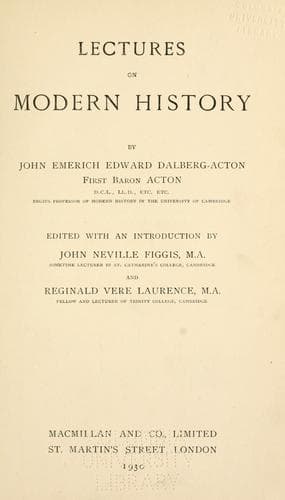
Lectures on Modern historyActon, John Emerich Edward Dalberg Acton, Baron
History
Lectures on Modern history
Acton, John Emerich Edward Dalberg Acton, Baron
History, Modern
Now it was these men, Pole, Contarini, and their friends Cortese and
Sadolet, who dominated in the Sacred College, occupied high places,
and helped to govern the policy of Rome. There were nests of
Lutherans at Modena, Naples, and elsewhere; but nobody in those days
knew the force of multitudes; a few cardinals caused greater alarm
than all the readers of the Benefizio, and it soon appeared that the
general of the Capuchins, the Bishop of Capo d'Istria, the Bishop of
Modena and Nuncio in Germany, inclined the same way as the suspected
cardinals. The most eminent men of the Italian clergy were steering
for Wittenberg, and taking Rome with them. An uncle of the Duke of
Alva, the cardinal of Sant Iago, thereupon suggested to Caraffa that
the best way to save the Church was to introduce the Spanish
Inquisition; and he was seconded by another Spaniard, a Basque of
great note in history, of whom there will be more to tell. Caraffa,
who had been Nuncio in Spain, took up the idea, urged it upon the
Pope, and succeeded. What he obtained was nothing new; it belonged to
the thirteenth century, and it had been the result of two forces
powerful at the time, the Crusades and the belief in witchcraft.
When the first warlike pilgrims started for Palestine at the end of
the eleventh century, it occurred to some of them that without toiling
so far they could find enemies of Christ, as bad as the Saracens,
close at hand. So they fell upon the Jews in the north of France,
along the Rhine and the Danube, and murdered them as they passed.
This was done at a moment of religious fervour. And when it became
known, in the same region, that there were heretics, the same cause
produced the same effects, and the clergy were not always able to save
them from the wrath of the populace. The many sects known by the name
of Albigenses were Gnostics; but they were better known as Manichees,
for the Roman law was severe on Manichees, who were dualists, and by a
dualist they meant a worshipper of the devil. Sorcery had not become
epidemic and sectarian, but it was suspected occasionally in the
twelfth century. We know at the present day to what horrible and
loathsome rites Madame de Montespan submitted for the sake of love and
hatred. That was done in the most refined and enlightened court in
Europe, in the best days of the French intellect, in the home of
Bossuet and Racine. It is not difficult to imagine what was believed
and what was attempted in ignorant and criminal classes five centuries
earlier. Now a witch was, by the hypothesis, a worshipper of the
devil, and the dualists fell under the same suspicion of propitiation
by sin. It was impossible to exterminate them too quickly, or to
devise torments worse than they deserved.
Public-domain text, read in full here on John Shaqi.
Reviews
Reviews
No reviews yet
Be the first to share your thoughts on this work.
Elsewhere in the archive
Join the Discussion
Join the discussion
Sign in to leave a comment or review.
Sign InorCreate an account