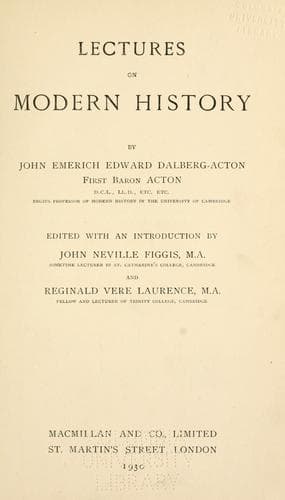
Lectures on Modern historyActon, John Emerich Edward Dalberg Acton, Baron
History
Lectures on Modern history
Acton, John Emerich Edward Dalberg Acton, Baron
History, Modern
In Austria conditions were of another kind. The country was largely
Protestant, and the Emperor, Maximilian II, was not only a friend to
toleration, but to Lutheran ideas. Under his auspices a conciliatory,
neutral, and unconventional Catholicism came into existence, accepting
the doctrinal compromise which had been tendered more than once,
discouraging pilgrimages, relics, indulgences, celibacy, and much that
had been the occasion of scoffing, an approach to Erasmus, if not to
Luther. The outward sign was the restoration of the cup. When his
restraining hand was removed, the process of reaction which had done
well on the Rhine was extended to the Danube and the Illyrian Alps,
with like success. And it was the steady pursuit of this policy in
Austria that provoked the Thirty Years' War. In Poland, too, where
toleration had been conceded in the avowed expectation that the sects
would devour each other, it was exchanged for acts like those I have
described. The result of the struggle was that the boundary receded,
that a time came of recovery for the Catholics and of decline for the
Lutherans in central Europe, and that the distribution has remained
practically unchanged. The only example of a country becoming
Protestant since then occurred when the principles of the
Counter-Reformation, applied by Alva, drove the Netherlands into
revolt, and changed the Reformation into revolution. The great and
rapid victories of the sixteenth century were gained over the
unreformed and disorganised Catholicism of the Renaissance, not over
the Church which had been renovated at Trent. Rome, with a contested
authority and a contracted sphere, developed greater energy, resource,
and power than when it exercised undivided sway over Christendom in
the West. The recovery was accomplished by violence, and was due to
the advent of men who did not shrink from blood in place of the
gracious idealists for whom Luther and Calvin were too strong.
VI
CALVIN AND HENRY VIII
Public-domain text, read in full here on John Shaqi.
Reviews
Reviews
No reviews yet
Be the first to share your thoughts on this work.
Elsewhere in the archive
Join the Discussion
Join the discussion
Sign in to leave a comment or review.
Sign InorCreate an account