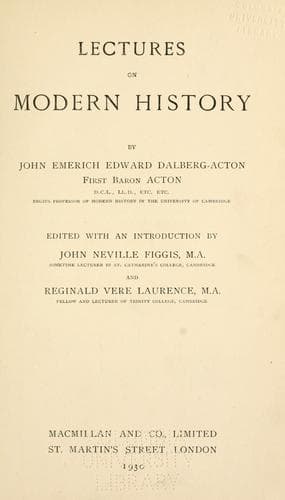
Lectures on Modern historyActon, John Emerich Edward Dalberg Acton, Baron
History
Lectures on Modern history
Acton, John Emerich Edward Dalberg Acton, Baron
History, Modern
The House of Commons followed up its victory by passing the Test Act,
excluding Catholics from office. The Duke of York resigned his post as
Lord High Admiral. It was, he said, the beginning of the scheme for
depriving him of the succession to the throne. In November 1673
Shaftesbury, who had promoted the Declaration of Indulgence, was
dismissed from office and went into opposition, for the purposes of
which Lewis sent him L10,000. He learnt from Arlington the main
particulars of the Treaty of Dover, and in the following month of
January the secret was substantially made public in a pamphlet, which
is reprinted in the State Tracts. From that moment he devoted himself
to the exclusion of James.
In 1676 the Duke of York made it known that he had become a Catholic.
This was so gratuitous that people took it to mean that he was strong
in the support which the French king gave him. He was still true to
the policy of the Dover Treaty, which his brother had abandoned, and
still watched his opportunity to employ force for the restoration of
his Church. All this was fully understood, and his enemy, Shaftesbury,
was implacable.
When he had been five years out of office, in September 1678, Titus
Oates appeared. Who the people were who brought him forward, with the
auxiliary witnesses, Bedloe, Dangerfield, and Turberville, the one who
received L600 for his evidence against Stafford, is still unknown.
Shaftesbury was not the originator. He would not have waited so many
years. His part in the affair was to employ the public alarm for the
destruction of the Duke of York. Therefore, from the summer of 1678
there was a second plot. The first, consisting in the Treaty of
Dover, drawn up by the Catholic advisers, Arundel, Bellasis, the
historian Belling, and Leighton, the great archbishop's brother. The
second was the Protestant plot against the Catholics, especially the
Duke of York. The indignation against the real plot, that of Dover,
was essentially political.
Public-domain text, read in full here on John Shaqi.
Reviews
Reviews
No reviews yet
Be the first to share your thoughts on this work.
Elsewhere in the archive
Join the Discussion
Join the discussion
Sign in to leave a comment or review.
Sign InorCreate an account