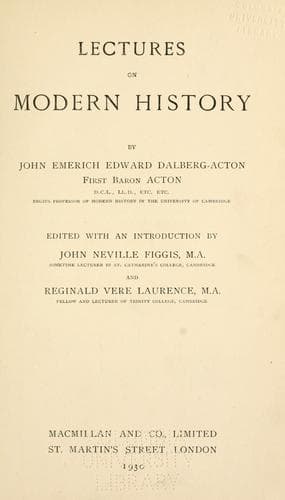
Lectures on Modern historyActon, John Emerich Edward Dalberg Acton, Baron
History
Lectures on Modern history
Acton, John Emerich Edward Dalberg Acton, Baron
History, Modern
It was during this struggle against the overshadowing suspicion of the
Dover Treaty that the Habeas Corpus Act was passed, and that Party
took shape in England. In general, the old cavalier families, led by
the clergy and the lawyers, acquiesced in the royal prerogative, the
doctrine of passive obedience, the absolute and irresistible authority
of that which Hobbes called Leviathan, meaning the abstract notion of
the State. They had a passion for order, not for oppression; good
government was as dear to them as to their opponents, and they
believed that it would not be secured if the supreme authority was
called in question. That was the Court Party, known as Tories. As
time went on, after the Revolution, they underwent many developments.
But at first they were simply defenders of royal authority against
aggression, without any original ideas.
The Country Party was the party of reform. They were the people
excluded from the public service by the oath in favour of
non-resistance. They believed in the rightfulness of the war which the
Long Parliament waged against the king, and were prepared, eventually,
to make war against Charles II. That was the essential distinction
between them and the Tories. They dreaded revolution, but, in an
extreme case, they thought it justifiable. "Acts of tyranny," said
Burnet, "will not justify the resistance of subjects, yet a total
subversion of their constitution will." When Burnet and Tillotson
urged this doctrine on Lord Russell, he replied that he did not see a
difference between a legal and a Turkish Constitution, upon this
hypothesis.
Whig history exhibits a gradual renunciation of Burnet's mitigated
doctrine, that resistance is only justified by extreme provocation,
and a gradual approach to the doctrine of Russell, on which the
American Revolution proceeded. The final purpose of the Whigs was not
distinct from that of their fathers in the Long Parliament. They
desired security against injustice and oppression. The victors in the
Civil War sought this security in a Republic, and in this they
conspicuously failed. It was obvious that they made a mistake in
abolishing the monarchy, the Established Church, and the House of
Lords. For all these things came back, and were restored as it were by
the force of Nature, not by the force of man.
Public-domain text, read in full here on John Shaqi.
Reviews
Reviews
No reviews yet
Be the first to share your thoughts on this work.
Elsewhere in the archive
Join the Discussion
Join the discussion
Sign in to leave a comment or review.
Sign InorCreate an account