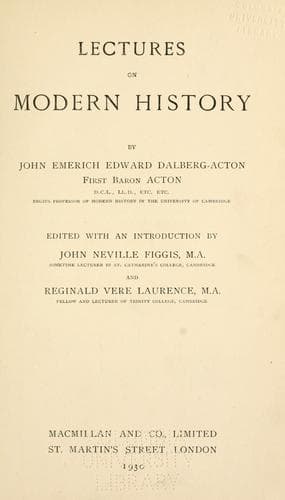
Lectures on Modern historyActon, John Emerich Edward Dalberg Acton, Baron
History
Lectures on Modern history
Acton, John Emerich Edward Dalberg Acton, Baron
History, Modern
A still more delicate negotiation was pursued on the Continent.
William could not allow it to appear that his expedition implied a war
of religion. He would forfeit the alliance of the Emperor, which was
the very pivot of his policy. Leopold was a devout and scrupulous
man, and it was uncertain how he would regard an enterprise which was
to substitute a Protestant dynasty for a Catholic dynasty in England.
There was only one way of ensuring his assistance. In order to have
the support of the Empire it was requisite to obtain the support of
the Papacy. In a religious question Leopold would follow the pope.
William sent one of his generals, the Prince de Vaudemont, to Rome;
and, through Count Dohna, he opened a correspondence with the Vatican.
He represented that the Catholics would obtain from him the toleration
which they could never be sure of under James. There would be not
only a serious political advantage gained by the detachment of England
from the French interest, but also a positive and measurable benefit
for the Church of Rome. The pope understood and assented, and took
the Habsburgs with him into the camp of the Great Deliverer. This is
the touch of mystery in the Revolution of 1688. James, the champion
of the Church, had alienated Rome.
The pope, Innocent XI, Odescalchi, is a rare and original figure, and
James said truly that no man like him had sat on the see of Rome for
centuries. He began the reform of the court, which consisted in the
abolition of nepotism. All through the century his predecessors had
founded great princely families--Borghese, Ludovisi, Barberini,
Pamphili, Chigi, Rospigliosi, Altieri. These great houses grew wealthy
out of the spoils of the Church, and, as their founders died without
making restitution, opponents of nepotism affirmed that they died
unrepentant, and might be found in those regions of the other world
where Dante delighted to exhibit the pontiffs of his time. In his zeal
for a strict morality Innocent tried to rectify the teaching of the
Casuists, and was involved in trouble with the Jesuits. In France he
was spoken of as a Jansenist, and in England Oldmixon called him a
Protestant pope. He endeavoured, as nobody had done since the
Reformation, to find a remedy for the divisions of Western
Christendom. The movement had not ceased since Richelieu was minister
and Grotius ambassador at Paris, and it became active on both
sides. Innocent sanctioned a scheme of concessions which was deemed
satisfactory in the universities of Protestant Germany.
Public-domain text, read in full here on John Shaqi.
Reviews
Reviews
No reviews yet
Be the first to share your thoughts on this work.
Elsewhere in the archive
Join the Discussion
Join the discussion
Sign in to leave a comment or review.
Sign InorCreate an account