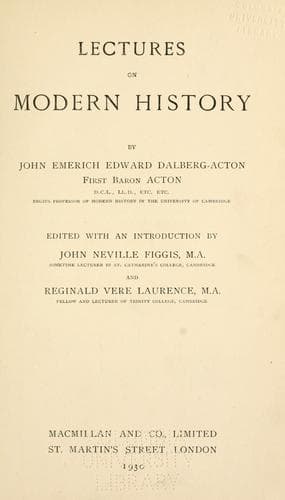
Lectures on Modern historyActon, John Emerich Edward Dalberg Acton, Baron
History
Lectures on Modern history
Acton, John Emerich Edward Dalberg Acton, Baron
History, Modern
The queen's death, about the same time, caused a greater change. The
king married Madame de Maintenon. He had been unfaithful to his first
wife, but now he was a model husband. The second wife, who never
became a queen, and was never acknowledged, ruled over his later
years. She was the most cultivated, thoughtful, and observant of
women. She had been a Protestant, and retained, for a long time, the
zeal of a convert. She was strongly opposed to the Jansenists, and
was much in the confidence of the best men among the clergy. It was
universally believed that she promoted persecution, and urged the king
to revoke the Edict of Nantes. Her letters are produced in evidence.
But her letters have been tampered with by an editor, who was a forger
and a falsifier.
The Revocation required no such specific agency, but proceeded by
consistent logic, from the tenor of the reign. The theory of
government, which is that which Bossuet borrowed from Hobbes, and
clothed in the language of Scripture, does not admit that a subject
should have a will, a conviction, a conscience of his own, but expects
that the spiritual side of him shall be sacrificed to the sovereign,
like his blood and treasure. Protestant liberties, respected by
Richelieu and still more entirely by Mazarin, who acknowledged the
loyalty of Huguenots in the Fronde, became an exotic, an anachronism,
a contradiction, and a reproach, as absolute monarchy rose to the
zenith. The self-government of the Gallican Church, the administration
of the clergy by the clergy, was reduced to the narrowest limits, and
the division of power between Church and State was repressed in favour
of the State. It could not be borne, in the long-run, that
Protestants should govern themselves, while Catholics could not.
The clergy, zealous for the extinction of Jansenism, naturally
extended their zeal against those who were more hostile to their
Church than Jansenists. Everything else was required to give way to
the governing will, and to do honour to the sovereign. The
Protestants, under their protecting immunity, were a belated and
contumelious remnant of quite another epoch. Exceptions which were
tolerable under the undeveloped monarchy were revolting when it had
grown to its radiant perfection. The one thing wanting was the
Revocation, to abolish the memory of an age in which a king whose
throne was insecure conceded to turbulent and disloyal subjects that
which the sovereign of a loyal and submissive people would do well to
revoke. To fulfil the ideal of royalty, the monument of the weakness
of royalty and the strength of revolution must be ingeniously hidden
away. The ardour of rising absolutism is the true cause of the
Revocation.
Public-domain text, read in full here on John Shaqi.
Reviews
Reviews
No reviews yet
Be the first to share your thoughts on this work.
Elsewhere in the archive
Join the Discussion
Join the discussion
Sign in to leave a comment or review.
Sign InorCreate an account