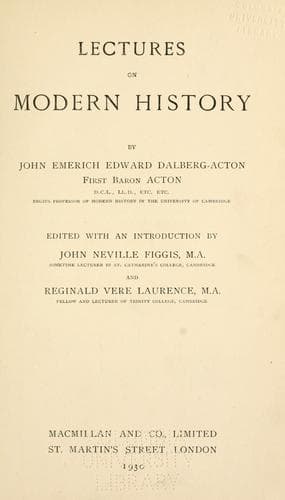
Lectures on Modern historyActon, John Emerich Edward Dalberg Acton, Baron
History
Lectures on Modern history
Acton, John Emerich Edward Dalberg Acton, Baron
History, Modern
This was the turn in the fortunes of Lewis. He ravaged twenty miles
of the Palatinate for the sake of a claim on the part of the Duchess
of Orleans, who was a Princess Palatine. His armies were victorious,
as usual, at Steenkerk and at Landen. The English were driven to the
north-eastern extremity of Ireland; and Trouville had better reason
than Van Tromp to fix a broom at his masthead. And then Ireland was
lost. The French fleet was destroyed, by very superior numbers, at La
Hogue, and the Grand Alliance, aided at last by the ships, and the
men, and the money of England, bore down the resistance of exhausted
France. William was acknowledged King of England at the close of a
struggle which had begun twenty-five years before. Lewis, having
formally offered to support James's election to the throne of Poland,
when Sobieski died, gave him up. Vauban complained that the war had
been too prosperous on the Continent to justify so disastrous a
termination.
From the peace of Ryswick the lengthening shadow of the Spanish
succession falls upon the scene, and occupies the last years alike of
William, of Leopold, and of Lewis. It was known that the King of
Spain could not live long; and as the prize came near, Europe, for
four years, was hushed in expectation.
XV
THE WAR OF THE SPANISH SUCCESSION
WE COME now to the last and greatest transaction in Lewis XIV's
reign--the acquisition of the Spanish crown.
The idea of a predominant Power in Europe was part of absolutism. It
proceeded from the same love of authority, the same pride of
greatness, the same disregard for the equal rights of men, the same
pretensions to superiority and prerogative, international as well as
national. The position of the king in Europe was security for his
position in France itself. Subjects were more willing to submit to
one to whom foreigners submitted. In three successive wars Lewis had
striven for this advantage, and had made himself felt as the public
enemy and the vigilant disturber of the peace of Europe. If he added
Spain to his dominions by legal and pacific means, by negotiated
treaty or testamentary bequest, it would be more legitimate than his
former attempts at mastery. His mother was a Spanish princess. His
wife was a Spanish princess. The emperor was in the same position,
but in each case the Queen of France was the elder sister. Both of
the French queens had resigned their claims; but Lewis had not
confirmed his wife's renunciation, as her dowry was left unpaid; and
it was not confirmed by the national authorities in Spain.
Public-domain text, read in full here on John Shaqi.
Reviews
Reviews
No reviews yet
Be the first to share your thoughts on this work.
Elsewhere in the archive
Join the Discussion
Join the discussion
Sign in to leave a comment or review.
Sign InorCreate an account