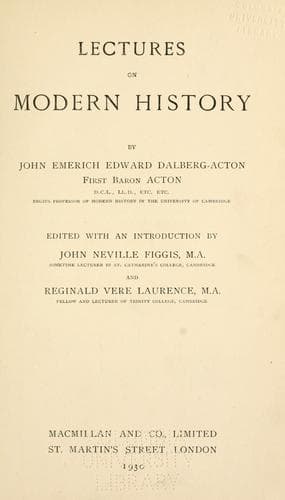
Lectures on Modern historyActon, John Emerich Edward Dalberg Acton, Baron
History
Lectures on Modern history
Acton, John Emerich Edward Dalberg Acton, Baron
History, Modern
The commercial, economical, and pacific spirit was evident, both in
England and Holland. On the other side, there was the strong will and
infinite dexterity of William. In the last Partition Treaty he had
betrayed this weakness of his position, and had given way to the
skilled diplomacy of France. Lewis did not believe that he would
prevail over the public opinion of his country. And if he did
prevail, his position would be less formidable than before. Lewis now
had Spain on his side, and all the dependencies of Spain. He also had
Bavaria and Savoy. In the last war he had been unsuccessful at sea,
and in the Irish expedition, which was carried on beyond the sea by
his naval, not his military administration. In the coming war he
would trust less to his fleet than to his troops, which had never been
unsuccessful in a general action. He resolved to defy the Dutch and
the English, and to seize every attainable advantage. The Spanish
ambassador had exclaimed, "The Pyrenees have melted away." Lewis now
announced that his grandson was not to renounce his right to the
throne of France. In the Barrier Fortresses the Dutch held garrisons.
Lewis sent them home and occupied the places himself. "Dutchmen were
not wanted," he said, "to protect one Bourbon against the other." In
August 1701 he obtained for French traders the asiento, the profitable
and coveted monopoly in negro slaves. In September he prohibited
English imports. Then, on the 16th, he did one thing more, one thing
too much even for a nation of economists and calculators.
The acceptance of the Spanish succession by France was the frustration
of William's efforts during thirty years. He had striven and made war
for peace and civilisation against wilful attack and the reign of
force. That good cause was defeated now, and the security of national
rights and international conventions was at an end. The craving for
empire and the hegemony of Europe had prevailed. The temper of England
compelled him, in April 1701, to acknowledge Philip of Anjou. The
country, he said, could not understand the refusal to acknowledge a
king welcomed by the whole of Spain. He advised the Emperor to have
the German princes with him, and to begin the attack. He himself would
arm meanwhile, and his own people, before long, would drive him into
war. He relied on the arrogance of the French, and this calculation,
the measures by which he brought public opinion on to his side, are
the greatest achievement of his career.
Public-domain text, read in full here on John Shaqi.
Reviews
Reviews
No reviews yet
Be the first to share your thoughts on this work.
Elsewhere in the archive
Join the Discussion
Join the discussion
Sign in to leave a comment or review.
Sign InorCreate an account