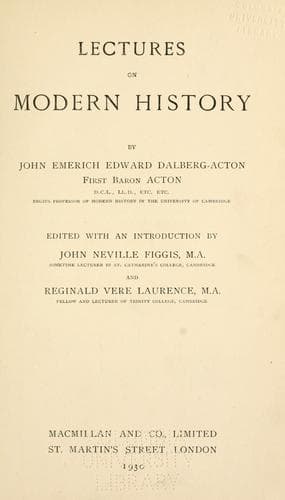
Lectures on Modern historyActon, John Emerich Edward Dalberg Acton, Baron
History
Lectures on Modern history
Acton, John Emerich Edward Dalberg Acton, Baron
History, Modern
What gave to this country the advantage in the war of the Spanish
Succession was the genius and the overwhelming personal ascendency of
Marlborough. One of the Dutch deputies, who did not love him, who was
not even quite convinced as to his qualities as a soldier, describes
him as perfectly irresistible, not so much by energy and visible
power, as by his dexterity and charm. And this in spite of defects
that were notorious and grotesque. Everybody knows, and perhaps
nobody believes, the story of his blowing out the candle when he found
that his visitor had no papers to read. Many years later the story
was told, when an officer present stated that he was the visitor whom
the duke had treated so parsimoniously. It is due to him that England
became one of the great Powers of the world, and, next to France, the
first of the Powers. And it was not his doing, but the doing of his
rivals, that the allies were sacrificed. The Dutch had no such
splendid personality, and though they had their full share in the war,
they lost by the result. The character of the struggle changed by the
death of William and the substitution of Marlborough, who depended,
more and more, on the support of the Whigs. In one of his last
conversations William had said: "We seek nothing but the security
which comes from the balance of power." Our policy was not maintained
throughout on that exalted level.
The War of Succession began in Italy, by the attempt of Eugene to
recover Milan, which reverted to the empire on the death of Charles
II. It was, as it were, a private affair, involving no declaration of
war, no formal breach with France. But the French were in Lombardy,
and, with the support of the Duke of Savoy, they were able to check
the Austrian advance. Eugene went home to Vienna to organise and
direct and urge the exertions of his government. On his return, after
a very memorable absence, Victor Amadeus had deserted his French
alliance, and had attached himself to the Austrians. A French army
laid siege to Turin, and Eugene, coming up the right bank of the Po to
his rescue, defeated the French, raised the siege, and established for
the first time the domination of Austria over Italy. He was repulsed
in his attempt on Toulon; but the Italian war was at an end, and the
emperor triumphant. In Germany the valley of the Danube, which is the
road to Vienna, was open to the French, because the elector of Bavaria
was their ally against his father-in-law, the emperor. The
Imperialists were in danger, and the Dutch, more solicitous of the
Belgian frontier before them than of what went on hundreds of miles
away, on the long line from Strasburg to the distant centre of
Austria, refused to let Marlborough take their troops away to another
seat of war in Southern Germany.
Public-domain text, read in full here on John Shaqi.
Reviews
Reviews
No reviews yet
Be the first to share your thoughts on this work.
Elsewhere in the archive
Join the Discussion
Join the discussion
Sign in to leave a comment or review.
Sign InorCreate an account