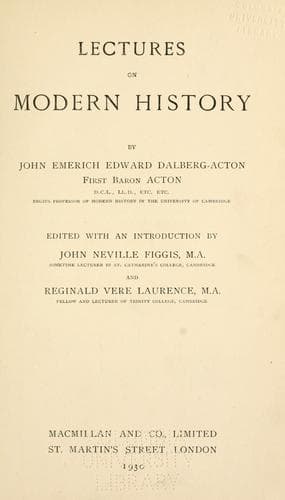
Lectures on Modern historyActon, John Emerich Edward Dalberg Acton, Baron
History
Lectures on Modern history
Acton, John Emerich Edward Dalberg Acton, Baron
History, Modern
The persuasions by which Peter bent Russia to his will were base and
atrocious; for, although one of the greatest men that have influenced
the course of Christian history, he is undoubtedly the worst of them;
but he was not working for himself; at Pultawa he told his troops that
they were fighting for Russia, not for him. His motive was
impersonal. He had grasped a great ideal, and he served it with
devotion, sacrificing everything to it, and not sparing himself. The
absolute State was the ideal, or rather the idol, for which he toiled,
the State as it had been devised by Machiavelli and Hobbes. To raise
the country by the employment of its own internal forces was an
unpromising and unprofitable enterprise. He, who was himself a
barbarian, could only accomplish his purpose by means of aid from
outside, by the instrumentality of those who had experience of a more
advanced order of things. The borrowed forces could only be applied
by the powers of a despot. That power, moreover, was already
provided. Muscovy had never been governed otherwise than by
irresponsible and irresistible authority. That authority had been
inactive and not deeply felt. Now the same authority interfered to
alter almost everything, except the subjection of the serf to the
landowner.
To enforce the supremacy of the State over society, and of will over
custom, Peter introduced his most characteristic institution. He made
precedence depend on public service, and regulated it according to
rank in the army in fourteen degrees, from the ensign to the marshal.
A new aristocracy superseded the old, and the ancient nobles were
forced to serve, in order to be somebody, when away from the ancestral
home. They were important, not by their possessions or their descent,
but by the position in which they stood towards the emperor. Peter
had imbibed too much of the rationalism of the West to be a
persecutor. He was severe with the schismatics, who existed only as
opponents of change and enemies of civilisation; and as there were no
Jews in Russia, he decreed that in future there should be none. But
he built churches for the foreigners whom he brought into the country,
and did not attempt to sustain the domination of the Muscovite clergy,
who, like the English, professed passive obedience, but obeyed without
approval. When the last patriarch was dying he expressed the wish
that all men of other faith--Catholic, Protestant, and Mahomedan--
should be burnt, and their places of worship levelled with the ground.
Public-domain text, read in full here on John Shaqi.
Reviews
Reviews
No reviews yet
Be the first to share your thoughts on this work.
Elsewhere in the archive
Join the Discussion
Join the discussion
Sign in to leave a comment or review.
Sign InorCreate an account