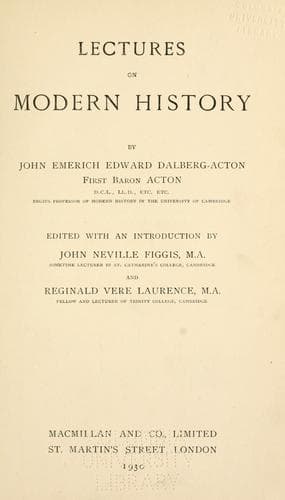
Lectures on Modern historyActon, John Emerich Edward Dalberg Acton, Baron
History
Lectures on Modern history
Acton, John Emerich Edward Dalberg Acton, Baron
History, Modern
Frederic underrated the value of the alliance, and mismanaged it
badly. He knew that there was a Whig dogma against letting England be
taken in tow by Hanover. The great propounder of the doctrine was
William Pitt, who now rose to power. Frederic did not know that this
turgid declaimer was as able, as powerful, as ambitious as himself,
and did not divine that he would make the German quarrel and the
compulsory defence of Hanover the means of occupying the military
forces of France until the contest for' oceanic empire was decided in
favour of England. Pitt declared that he would conquer America in
Germany. He armed one hundred and forty-eight ships of the line and
fifty frigates, with which he swept the Atlantic, and Montcalm, for
many months, received neither instructions nor supplies. But Frederic
required that the army in English pay, which was to defend Hanover,
and thus to cover his right flank, should be commanded by the Duke of
Cumberland. Upon this Pitt went out of office. The duke did not
justify the king's choice of him. He was beaten by d'Estrees, and
agreed to dissolve his force. But Pitt, who had soon returned to
power, rejected the Convention, gave Frederic a subsidy of L670,000 a
year, and maintained a force against the French, under Ferdinand of
Brunswick, who did his work well. There was more of English gold
in his camp than of English steel. One of our commanders was
court-martialled. When the Marquis of Granby did better, at Warburg,
the joy was great, and he became a popular hero. His hat and wig
were blown off as he led the charge, and his portrait, bareheaded,
in a high wind, is at Trinity, and was on the sign of many an inn,
especially of a well-known one at Dorking, in Mr. Pickwick's time.
On 21st July, 1756, when Frederic II discovered the whole of the peril
that confronted him, although it was far more than he had dreamt of,
he lost neither hope nor courage. His army of 145,000 men was not the
largest, but was much the best. Three or four of his generals, his
brother Henry, the Prince of Brunswick, Schwerin, who had served under
Eugene at Blenheim, and had followed Charles XII into Turkey, above
all, Seydlitz, were superior to the men on the other side, so far as
these were known. There were three millions in ready money, which was
enough for two campaigns in those economical days. The Russians had a
long march before them, in order to come within range; the French
might be left to the army of English mercenaries. The king might
hope, by energy and rapidity, to crush the Austrians in the valley of
the Elbe, which is Bohemia, or the valley of the Oder, which is
Silesia, before their friends came to aid them. Nearer still than
Austria were the Saxons, whose elector was King of Poland, and whose
minister, Bruhl, like Beust in 1866, was the centre of anti-Prussian
politics.
Public-domain text, read in full here on John Shaqi.
Reviews
Reviews
No reviews yet
Be the first to share your thoughts on this work.
Elsewhere in the archive
Join the Discussion
Join the discussion
Sign in to leave a comment or review.
Sign InorCreate an account