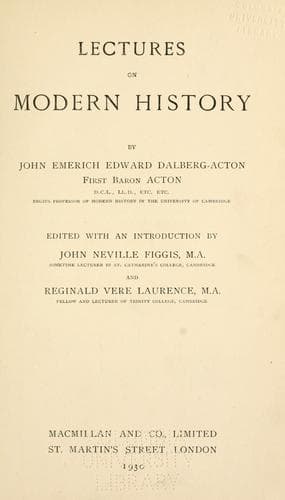
Lectures on Modern historyActon, John Emerich Edward Dalberg Acton, Baron
History
Lectures on Modern history
Acton, John Emerich Edward Dalberg Acton, Baron
History, Modern
Then came the larger question of taxation. Regulation of external
traffic was admitted. England patrolled the sea and protected America
from the smuggler and the pirate. Some remuneration might be
reasonably claimed; but it ought to be obtained in such a way as not
to hamper and prohibit the increase of wealth. The restrictions on
industry and trade were, however, contrived for the benefit of England
and to the injury of her colonies. They demanded that the arrangement
should be made for their mutual advantage. They did not go so far as
to affirm that it ought to be to their advantage only, irrespective of
ours, which is our policy with our colonies at the present time. The
claim was not originally excessive. It is the basis of the imputation
that the dispute, on both sides, was an affair of sordid interest. We
shall find it more just to say that the motive was empire on one side
and self-government on the other. It was a question between liberty
and authority, government by consent and government by force, the
control of the subject by the State, and the control of the State by
the subject. The issue had never been so definitely raised. In
England it had long been settled. It had been settled that the
legislature could, without breach of any ethical or constitutional
law, without forfeiting its authority or exposing itself to just
revolt, make laws injurious to the subject for the benefit of English
religion or English trade. If that principle was abandoned in America
it could not well be maintained in Ireland, and the green flag might
fly on Dublin Castle.
Public-domain text, read in full here on John Shaqi.
Reviews
Reviews
No reviews yet
Be the first to share your thoughts on this work.
Elsewhere in the archive
Join the Discussion
Join the discussion
Sign in to leave a comment or review.
Sign InorCreate an account