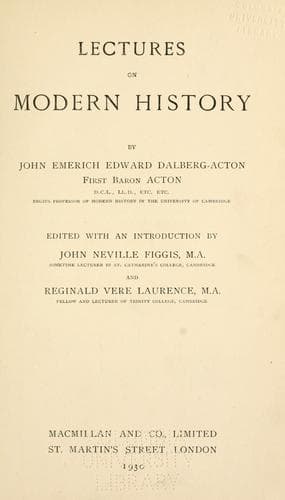
Lectures on Modern historyActon, John Emerich Edward Dalberg Acton, Baron
History
Lectures on Modern history
Acton, John Emerich Edward Dalberg Acton, Baron
History, Modern
The securities by which this purpose has been attempted compose
the problem of all later history, and centuries were spent in
ascertaining and constructing them. If in the main the direction
has been upward, the movement has been tardy, the conflict
intense, the balance often uncertain. The passion for power over
others can never cease to threaten mankind, and is always sure of
finding new and unforeseen allies in continuing its martyrology.
Therefore, the method of modern progress was revolution. By a
series of violent shocks the nations in succession have struggled
to shake off the Past, to reverse the action of Time and the
verdict of success, and to rescue the world from the reign of the
dead. They have been due less to provocation by actual wrong
than to the attraction of ideal right, and the claims that
inspired them were universal and detached. Progress has imposed
increasing sacrifices on society, on behalf of those who can make
no return, from whose welfare it derives no equivalent benefit,
whose existence is a burden, an evil, eventually a peril to the
community. The mean duration of life, the compendious test of
improvement, is prolonged by all the chief agents of civilisation,
moral and material, religious and scientific, working together,
and depends on preserving, at infinite cost, which is infinite
loss, the crippled child and the victim of accident, the idiot
and the madman, the pauper and the culprit, the old and infirm,
curable and incurable. This growing dominion of disinterested
motive, this liberality towards the weak, in social life,
corresponds to that respect for the minority, in political life,
which is the essence of freedom. It is an application of the
same principle of self-denial, and of the higher law.
Taking long periods, we perceive the advance of moral over
material influence, the triumph of general ideas, the gradual
amendment. The line of march will prove, on the whole, to have
been from force and cruelty to consent and association, to
humanity, rational persuasion, and the persistent appeal to
common, simple, and evident maxims. We have dethroned necessity,
in the shape both of hunger and of fear, by extending the scene
from Western Europe to the whole world, so that all shall
contribute to the treasure of civilisation, and by taking into
partnership in the enjoyment of its rewards those who are far off
as well as those who are below. We shall give our attention to
much that has failed and passed away, as well as to the phenomena
of progress, which help to build up the world in which we live.
For History must be our deliverer not only from the undue
influence of other times, but from the undue influence of our
own, from the tyranny of environment and the pressure of the air
we breathe. It requires all historic forces to produce their
record and submit to judgment, and it promotes the faculty of
resistance to contemporary surroundings by familiarity with other
ages and other orbits of thought.
Public-domain text, read in full here on John Shaqi.
Reviews
Reviews
No reviews yet
Be the first to share your thoughts on this work.
Elsewhere in the archive
Join the Discussion
Join the discussion
Sign in to leave a comment or review.
Sign InorCreate an account