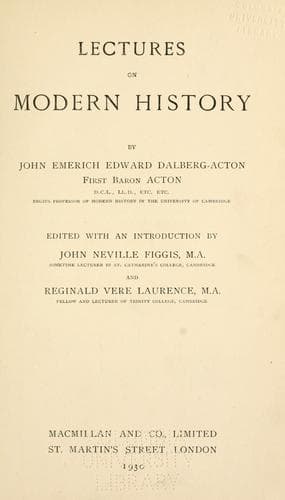
Lectures on Modern historyActon, John Emerich Edward Dalberg Acton, Baron
History
Lectures on Modern history
Acton, John Emerich Edward Dalberg Acton, Baron
History, Modern
In these latter days the sum of differences in international
character has been appreciably bound down by the constant process
of adaptation and adjustment, and by exposure to like influences.
The people of various countries are swayed by identical
interests, they are absorbed in the same problems, and thrill
with the same emotions; their classics are interchangeable,
authorities in science are nearly alike for all, and they readily
combine to make experiments and researches in common. Towards
1500, European nations, having been fashioned and composed out of
simple elements during the thousand years between the fall of the
Roman Empire and that of its successor is the East, had reached
full measure of differentiation. They were estranged from each
other, and were inclined to treat the foreigner as the foe.
Ancient links were loosened, the Pope was no longer an accepted
peacemaker; and the idea of an international code, overriding the
will of nations and the authority of sovereigns, had not dawned
upon philosophy. Between the old order that was changing and the
new that was unborn, Europe had an inorganic interval to go
through.
Modern History begins under stress of the Ottoman Conquest.
Constantinople fell, after an attempt to negotiate for help, by
the union of the Greek and Latin Churches. The agreement come to
at Florence was not ratified at home; the attempt was resented,
and led to an explosion of feeling that made even subjugation by
the Turk seem for the moment less intolerable, and that hastened
the catastrophe by making Western Christians slow to sacrifice
themselves for their implacable brethren in the East. Offers of
help were made, conditional on acceptance of the Florentine
decree, and were rejected with patriotic and theological disdain.
A small force of papal and Genoese mercenaries shared the fate of
the defenders, and the end could not have been long averted, even
by the restoration of religious unity. The Powers that held back
were not restrained by dogmatic arguments only. The dread of Latin
intolerance was the most favourable circumstance encountered by the
Turks in the Eastern Empire, and they at once offered protection
and immunities to the patriarch and his prelates. The conquest
of the entire peninsula, with the islands, occupied a generation,
and it was good policy meanwhile to do nothing that would diminish
the advantage or awaken alarm of persecution. Their system required
the increase rather than the conversion of Christian subjects,
for the tribute of gold as well as the tribute of blood. The
Janissaries were selected among the sons of Christian parents,
who became renegades, and who, having neither home nor family,
no life but in camp, no employment but arms, became not only the
best professional soldiers in the world, but a force constantly
active to undo the work of pacific statesmen and to find fresh
occasion for war. There were occasional outbreaks of blind ferocity,
Public-domain text, read in full here on John Shaqi.
Reviews
Reviews
No reviews yet
Be the first to share your thoughts on this work.
Elsewhere in the archive
Join the Discussion
Join the discussion
Sign in to leave a comment or review.
Sign InorCreate an account