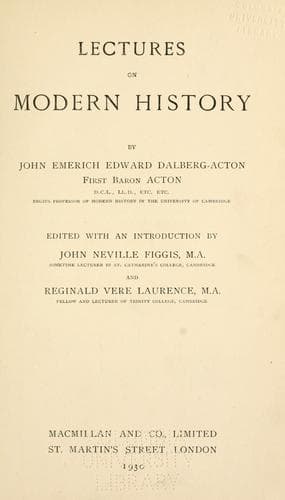
Lectures on Modern historyActon, John Emerich Edward Dalberg Acton, Baron
History
Lectures on Modern history
Acton, John Emerich Edward Dalberg Acton, Baron
History, Modern
Without a chart Magellan made his way through the perilous straits
that perpetuate his name in twelve days' sailing. Drake, who came
next, in 1577, took seventeen days, and Wallis, one hundred and
sixteen. And then, at Cape Deseado, the unbroken highway to the
fabled East, which had been closed against Columbus, opened before
him. The Spaniards discovered Cape Horn five years later, but it was
doubled for the first time in 1616 by the Dutchman who gave his name
to it. From the coast of Chili, Magellan sailed north-west for three
months, missing all the Pacific Islands until he came to the Ladrones.
He was killed while annexing the Philippines to the Crown of Spain,
and his lieutenant Delcano, the first circumnavigator, brought the
remnant of his crew home by the Cape. On 9th September, 1522,
thirteen wasted pilgrims passed barefoot in procession through the
streets of Seville, not so much in thanksgiving for that which had not
been given to man since the Creation, as in penance for having
mysteriously lost a day, and kept their feasts and fasts all wrong.
Magellan's acquisition of the Philippines lasted to the present year
(1899), but his design on the Moluccas was given up. Nobody knew,
until the voyage of Dampier, to whom, by the accepted boundary, they
belonged; and in 1529 Spain abandoned its claim for 350,000 ducats.
The Portuguese paid that price for what was by right their own; for
Magellan was entirely wrong both as to the meridian and as to the
South American route, which was much the longest, and was not followed
by sailors.
For more than twenty years Spain struggled vainly with the West Indian
problem. Four large islands and forty small ones, peopled by
barbarians, were beyond the range of Spanish experience in the art of
government. Grants of land were made, with the condition that the
holder should exercise a paternal rule over the thriftless
inhabitants. It was thought to pay better to keep them underground,
digging for gold, than to employ them on the surface. The mortality
was overwhelming; but the victims awakened little sympathy. Some
belonged to that Arcadian race that was the first revealed by the
landfall of Columbus, and they were considered incurably indolent and
vicious. The remainder came from the mainland and the region of the
Orinoco, and had made their way by the Windward Islands as far as San
Domingo, devouring the people they found there. Neither the stronger
nor the weaker race withstood the exhausting labour to which they were
put by taskmasters eager for gold. Entire villages committed suicide
together; and the Spaniards favoured a mode of correction which
consisted in burning Indians alive by a slow fire. Las Casas, who
makes these statements, and who may be trusted for facts and not for
figures, affirms that fifty millions perished in his time, and fifteen
millions were put to death.
Public-domain text, read in full here on John Shaqi.
Reviews
Reviews
No reviews yet
Be the first to share your thoughts on this work.
Elsewhere in the archive
Join the Discussion
Join the discussion
Sign in to leave a comment or review.
Sign InorCreate an account