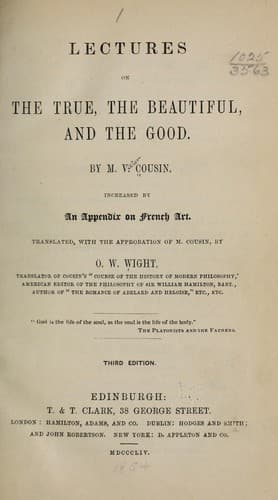
Lectures on the true, the beautiful and the goodCousin, Victor
Philosophy
Lectures on the true, the beautiful and the good
Cousin, Victor
Aesthetics; Ethics; Truth
I certainly admire Champagne as an historical painter, and even as a
landscape painter; but he is perhaps greatest as a portrait painter. In
portraits truth and nature are particularly in their place, relieved by
coloring, and idealized in proper measure by expression. The portraits
of Champagne are so many monuments in which his most illustrious
contemporaries will live forever. Every thing about them is strikingly
real, grave, and severe, with a penetrating sweetness. Should the
records of Port-Royal be lost, all Port-Royal might be found in
Champagne. Among those portraits we see the inflexible Saint-Cyran,[148]
as well as his persecutor, the imperious Richelieu.[149] We see, too,
the learned, the intrepid Antoine Arnaud, to whom the contemporaries of
Bossuet decreed the name of Great;[150] and Mme. Angelique Arnaud, with
her naive and strong figure.[151] Among them is mother Agnes and the
humble daughter of Champagne himself, sister St. Suzanne.[152] She has
just been miraculously cured, and her whole prostrated person bears
still the impress of a relic of suffering. Mother Agnes, kneeling before
her, regards her with a look of grateful joy. The place of the scene is
a poor cell; a wooden cross hanging on the wall, and some straw chairs,
are all the ornaments. On the picture is the inscription,--_Christo uni
medico animarum et corporum_, etc. There is possessed the Christian
stoicism of Port-Royal in its imposing austerity. Add to all these
portraits that of Champagne;[153] for the painter may be put by the side
of his personages.
Public-domain text, read in full here on John Shaqi.
Reviews
Reviews
No reviews yet
Be the first to share your thoughts on this work.
Elsewhere in the archive
Join the Discussion
Join the discussion
Sign in to leave a comment or review.
Sign InorCreate an account