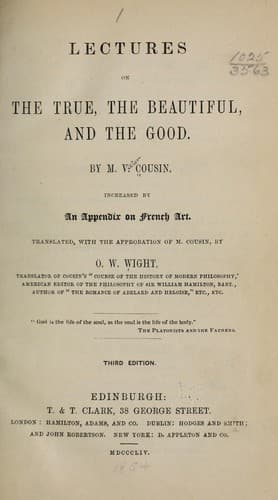
Lectures on the true, the beautiful and the goodCousin, Victor
Philosophy
Lectures on the true, the beautiful and the good
Cousin, Victor
Aesthetics; Ethics; Truth
[194] 1st Series, vol. iii., p. 193: "In the doctrine of interest, every
man seeks the useful, but he is not sure of attaining it. He may, by
dint of prudence and profound combinations, increase in his favor the
chances of success; it is impossible that there should not remain some
chances against him; he never pursues, then, any thing but a probable
result. On the contrary, in the doctrine of duty, I am always sure of
obtaining the last end that I propose to myself, moral good. I risk my
life to save my fellow; if, through mischance, I miss this end, there is
another which does not, which cannot, escape me,--I have aimed at the
good, I have been successful. Moral good, being especially in the
virtuous intention, is always in my power and within my reach; as to the
material good that can result from the action itself, Providence alone
disposes of it. Let us felicitate ourselves that Providence has placed
our moral destiny in our own hands, by making it depend upon the good
and not upon the useful. The will, in order to act in the sad trials of
life, has need of being sustained by certainty. Who would be disposed to
give his blood for an uncertain end? Success is a complicated problem,
that, in order to be solved, exacts all the power of the calculus of
probabilities. What labor and what uncertainties does such a calculus
involve! Doubt is a very sad preparation for action. But when one
proposes before all to do his duty, he acts without any perplexity. Do
what you ought, let come what may, is a motto that does not deceive.
With such an end, we are sure of never pursuing it in vain."
[195] See the development of the idea of right, lectures 14 and 15.
[196] See lecture 14, Theory of liberty.
[197] See the preceding lecture, and lectures 14 and 15.
[198] 1st part, lecture 1.
[199] See lecture 16.
[200] On the politics that are derived from the philosophy of sensation,
see the four lectures that we devoted to the exposition and refutation
of the doctrine of Hobbes, vol. iii. of the 1st Series.
[201] These words sufficiently mark the generous epoch in which we
pronounce them, without wounding the authority and the applauses of a
noble youth, when M. de Chateaubriand covered the Restoration with his
own glory, when M. Royer-Collard presided over public instruction, M.
Pasquier, M. Laine, M. de Serre over justice and the interior, Marshal
St. Cyr over war, and the Duke de Richelieu over foreign affairs, when
the Duke de Broglie prepared the true legislation of the press, and M.
Decazes, the author of the wise and courageous ordinance of September 5,
1816, was at the head of the councils of the crown; when finally, Louis
XVIII. separated himself, like Henry IV., from his oldest servants in
order to be the king of the whole nation.
Public-domain text, read in full here on John Shaqi.
Reviews
Reviews
No reviews yet
Be the first to share your thoughts on this work.
Elsewhere in the archive
Join the Discussion
Join the discussion
Sign in to leave a comment or review.
Sign InorCreate an account