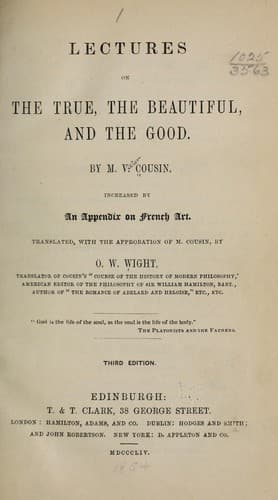
Lectures on the true, the beautiful and the goodCousin, Victor
Philosophy
Lectures on the true, the beautiful and the good
Cousin, Victor
Aesthetics; Ethics; Truth
If I have duties towards myself, it is not towards myself as an
individual, it is towards the liberty and intelligence that make me a
free moral person. It is necessary to distinguish closely in us what is
peculiar to us from what pertains to humanity. Each one of us contains
in himself human nature with all its essential elements; and, in
addition, all these elements are in him in a certain manner that is not
the same in two different men. These particularities make the
individual, but not the person; and the person alone in us is to be
respected and held as sacred, because it alone represents humanity.
Every thing that does not concern the moral person is indifferent. In
these limits I may consult my tastes, even my fancies to a certain
extent, because in them there is nothing absolute, because in them good
and evil are in no way involved. But as soon as an act touches the moral
person, my liberty is subjected to its law, to reason, which does not
allow liberty to be turned against itself. For example, if through
caprice, or melancholy, or any other motive, I condemn myself to an
abstinence too prolonged, if I impose on myself vigils protracted and
beyond my strength; if I absolutely renounce all pleasure, and, by these
excessive privations, endanger my health, my life, my reason, these are
no longer indifferent actions. Sickness, death, madness, may become
crimes, if we voluntarily bring them upon ourselves.
I have not established this obligation of self-respect imposed on the
moral person, therefore I cannot destroy it. Is self-respect founded on
one of those arbitrary conventions that cease to exist when the two
contracting parties freely renounce them? Are the two contracting
parties here _me_ and myself? By no means; one of the contracting
parties is not _me_, to wit, humanity, the moral person. And there is
here neither convention nor contract. By the fact alone that the moral
person is in us, we are obligated towards it, without convention of any
sort, without contract that can be cancelled, and by the very nature of
things. Hence it comes that obligation is absolute.
Respect of the moral person in us is the general principle whence are
derived all individual duties. We will cite some of them.
The most important, that which governs all others, is the duty of
remaining master of one's self. One may lose possession of himself in
two ways, either by allowing himself to be carried away, or by allowing
himself to be overcome, by yielding to enervating passions or to
overwhelming passions, to anger or to melancholy. On either hand there
is equal weakness. And I do not speak of the consequences of those vices
for society and ourselves,--certainly they are very injurious; but they
are much worse than that, they are already bad in themselves, because in
themselves they give a blow to moral dignity, because they diminish
liberty and disturb intelligence.
Public-domain text, read in full here on John Shaqi.
Reviews
Reviews
No reviews yet
Be the first to share your thoughts on this work.
Elsewhere in the archive
Join the Discussion
Join the discussion
Sign in to leave a comment or review.
Sign InorCreate an account