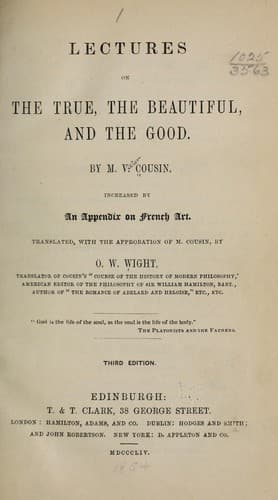
Lectures on the true, the beautiful and the goodCousin, Victor
Philosophy
Lectures on the true, the beautiful and the good
Cousin, Victor
Aesthetics; Ethics; Truth
Let us pause on the threshold of politics, properly so called. Nothing
in them but these principles is fixed and invariable; all else is
relative. The constitutions of states have something absolute by their
relation to the inviolable rights which they ought to guarantee; but
they also have a relative side by the variable forms with which they are
clothed, according to times, places, manners, history. The supreme rule
of which philosophy reminds politics, is that politics ought, in
consulting all circumstances, to seek always those social forms and
institutions that best realize those eternal principles. Yes, they are
eternal; because they are drawn from no arbitrary hypothesis, because
they rest on the immutable nature of man, on the all-powerful instincts
of the heart, on the indestructible notion of justice, and the sublime
idea of charity, on the consciousness of person, liberty, and equality,
on duty and right, on merit and demerit. Such are the foundations of
all true society, worthy of the beautiful name of human society, that is
to say, formed of free and rational beings; and such are the maxims that
ought to direct every government worthy of its mission, which knows that
it is not dealing with beasts but with men, which respects them and
loves them.
Thank God, French society has always marched by the light of this
immortal idea, and the dynasty that has been at its head for some
centuries has always guided it in these generous ways. It was Louis le
Gros, who, in the Middle Age, emancipated the communes; it was Philippe
le Bel who instituted parliaments--an independent and gratuitous
justice; it was Henri IV. who began religious liberty; it was Louis
XIII. and Louis XIV. who, while they undertook to give to France her
natural frontiers, and almost succeeded in it, labored to unite more and
more all parts of the nation, to put a regular administration in the
place of feudal anarchy, and to reduce the great vassals to a simple
aristocracy, from day to day deprived of every privilege but that of
serving the common country in the first rank. It was a king of France
who, comprehending the new wants, and associating himself with the
progress of the times, attempted to substitute for that very real, but
confused and formless representative government, that was called the
assemblies of the nobility, the clergy, and the _tiers etat_, the true
representative government that is proper for great civilized nations,--a
glorious and unfortunate attempt that, if royalty had then been served
by a Richelieu, a Mazarin, or a Colbert, might have terminated in a
necessary reform, that, through the fault of every one, ended in a
revolution full of excess, violence, and crime, redeemed and covered by
an incomparable courage, a sincere patriotism, and the most brilliant
triumphs. Finally, it was the brother of Louis XVI. who, enlightened and
not discouraged by the misfortunes of his family, spontaneously gave to
Public-domain text, read in full here on John Shaqi.
Reviews
Reviews
No reviews yet
Be the first to share your thoughts on this work.
Elsewhere in the archive
Join the Discussion
Join the discussion
Sign in to leave a comment or review.
Sign InorCreate an account