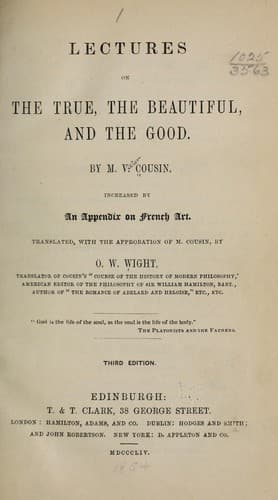
Lectures on the true, the beautiful and the goodCousin, Victor
Philosophy
Lectures on the true, the beautiful and the good
Cousin, Victor
Aesthetics; Ethics; Truth
[237] On the danger of seeking at first the origin of human knowledge,
see 1st Series, vol. iii., lecture on Hobbes, p. 261: "Hobbes is not the
only one who took the question of the origin of societies as the
starting-point of political science. Nearly all the publicists of the
eighteenth century, Montesquieu excepted, proceed in the same manner.
Rousseau imagines at first a primitive state in which man being no
longer savage without being yet civilized, lived happy and free under
the dominion of the laws of nature. This golden age of humanity
disappearing carries with it all the rights of the individual, who
enters naked and disarmed into what we call the social state. But order
cannot reign in a state without laws, and since natural laws perished in
the shipwreck of primitive manners, new ones must be created. Society is
formed by aid of a contract whose principle is the abandonment by each
and all of their individual force and rights to the profit of the
community, of the state, the instrument of all forces, the depository of
all rights. The state, for Hobbes, will be a man, a monarch, a king; for
Rousseau, the state is the collection itself of citizens, who by turns
are considered as subjects and governors, so that instead of the
despotism of one over all, we have the despotism of all over each. Law
is not the more or less happy, more or less faithful expression of
natural justice; it is the expression of the general will. This general
will is alone free; particular wills are not free. The general will has
all rights, and particular wills have only the rights that it confers on
them, or rather lends them. Force, in _The Citizen_ is the foundation of
society, of order, of laws, of the rights and duties which laws alone
institute. In the _Contrat Social_, the general will plays the same
part, fulfils the same function. Moreover, the general will scarcely
differs in itself from force. In fact, the general will is number, that
is to say, force still. Thus, on both sides, tyranny under different
forms. One may here observe the power of method. If Hobbes, if Rousseau
especially had at first studied the idea of right in itself, with the
certain characters without which we are not able to conceive it, they
would have infallibly recognized that if there are rights derived from
positive laws, and particularly from conventions and contracts, there
are rights derived from no contract, since contracts take them for
principles and rules; from no convention, since they serve as the
foundation to all conventions in order that these conventions may be
reputed just;--rights that society consecrates and develops, but does
not make,--rights not subject to the caprices of general or particular
will, belonging essentially to human nature, and like it, inviolable and
sacred."
Public-domain text, read in full here on John Shaqi.
Reviews
Reviews
No reviews yet
Be the first to share your thoughts on this work.
Elsewhere in the archive
Join the Discussion
Join the discussion
Sign in to leave a comment or review.
Sign InorCreate an account