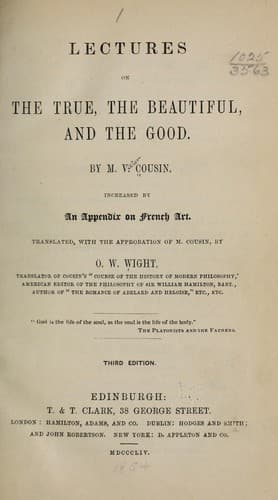
Lectures on the true, the beautiful and the goodCousin, Victor
Philosophy
Lectures on the true, the beautiful and the good
Cousin, Victor
Aesthetics; Ethics; Truth
perfect strictness that the subject of the exterior phenomena has the
character of the latter, and that the subject of the phenomena of
consciousness has the character of the former; that the one is solid and
extended, and that the other is neither solid nor extended. Finally, as
that which is solid and extended is divisible, and as that which is
neither solid nor extended is indivisible, hence divisibility is
attributed to the solid and extended subject, and indivisibility
attributed to the subject which is neither extended nor solid. Who of
us, in fact, does not believe himself an indivisible being, one and
identical, the same yesterday, to-day, and to-morrow? Well, the word
body, the word matter, signifies nothing else than the subject of
external phenomena, the most eminent of which are form, impenetrability,
solidity, extension, divisibility. The word mind, the word soul,
signifies nothing else than the subject of the phenomena of
consciousness, thought, will, sensation, phenomena simple, unextended,
not solid, etc. Behold the whole idea of spirit, and the whole idea of
matter! See, therefore, all that must be done in order to bring back
matter to spirit, and spirit to matter: it is necessary to pretend that
sensation, volition, thought, are reducible in the last analysis to
solidity, extension, figure, divisibility, etc., or that solidity,
extension, figure, etc., are reducible to thought, volition, sensation."
1st Series, vol. iii., lecture I, _Locke_. "Locke pretends that we
cannot be certain _by the contemplation of our own ideas_, that matter
cannot think; on the contrary, it is in the contemplation itself of our
ideas that we clearly perceive that matter and thought are incompatible.
What is thinking? Is it not uniting a certain number of ideas under a
certain unity? The simplest judgment supposes several terms united in a
subject, one and identical, which is _me_. This identical _me_ is
implied in every real act of knowledge. It has been demonstrated to
satiety that comparison exacts an indivisible centre that comprises the
different terms of the comparison. Do you take memory? There is no
memory possible without the continuation of the same subject that refers
to self the different modifications by which it has been successively
affected. Finally, consciousness, that indispensable condition of
intelligence,--is it not the sentiment of a single being? This is the
reason why each man cannot think without saying _me_, without affirming
that he is himself the identical and one subject of his thoughts. I am
_me_ and always _me_, as you are always yourself in the most different
acts of your life. You are not more yourself to-day than you were
yesterday, and you are not less yourself to-day than you were yesterday.
This identity and this indivisible unity of the _me_ inseparable from
the least thought, is what is called its spirituality, in opposition to
the evident and necessary characters of matter. By what, in fact, do you
Public-domain text, read in full here on John Shaqi.
Reviews
Reviews
No reviews yet
Be the first to share your thoughts on this work.
Elsewhere in the archive
Join the Discussion
Join the discussion
Sign in to leave a comment or review.
Sign InorCreate an account