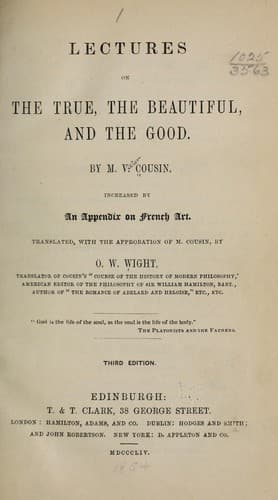
Lectures on the true, the beautiful and the goodCousin, Victor
Philosophy
Lectures on the true, the beautiful and the good
Cousin, Victor
Aesthetics; Ethics; Truth
Object of the lecture: What is the ultimate basis of absolute
truth?--Four hypotheses: Absolute truth may reside either in us,
in particular beings and the world, in itself, or in God. 1. We
perceive absolute truth, we do not constitute it. 2. Particular
beings participate in absolute truth, but do not explain it;
refutation of Aristotle. 3. Truth does not exist in itself;
defence of Plato. 4. Truth resides in God.--Plato; St.
Augustine; Descartes; Malebranche; Fenelon; Bossuet;
Leibnitz.--Truth the mediator between God and man.--Essential
distinctions.
We have justified the principles that govern our intelligence; we have
become confident that there is truth outside of us, that there are
verities worthy of that name, which we can perceive, which we do not
make, which are not solely conceptions of our mind, which would still
exist although our mind should not perceive them. Now this other problem
naturally presents itself: What, then, in themselves, are these
universal and necessary truths? where do they reside? whence do they
come? We do not raise this problem, and the problems that it embraces;
the human mind itself proposes them, and it is fully satisfied only when
it has resolved them, and when it has reached the extreme limit of
knowledge that it is within its power to attain.
It is certain that the principles which, in all the orders of knowledge,
discover to us absolute and necessary truths, constitute part of our
reason, which surely makes its dwelling in us, and is intimately
connected with personality in the depths of intellectual life. It
follows that the truth, which reason reveals to us, falls thereby into
close relation with the subject that perceives it, and seems only a
conception of our mind. Nevertheless, as we have proved, we perceive
truth, we are not the authors of it. If the person that I am, if the
individual _me_ does not, perhaps, explain the whole of reason, how
could it explain truth, and absolute truth? Man, limited and passing
away, perceives necessary, eternal, infinite truth; that is for him a
privilege sufficiently high; but he is neither the principle that
sustains truth, nor the principle that gives it being. Man may say, My
reason; but give him credit for never having dared to say, My truth.
Public-domain text, read in full here on John Shaqi.
Reviews
Reviews
No reviews yet
Be the first to share your thoughts on this work.
Join the Discussion
Join the discussion
Sign in to leave a comment or review.
Sign InorCreate an account