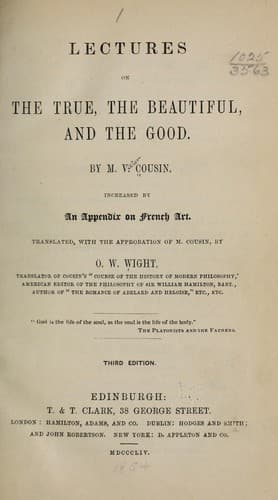
Lectures on the true, the beautiful and the goodCousin, Victor
Philosophy
Lectures on the true, the beautiful and the good
Cousin, Victor
Aesthetics; Ethics; Truth
3d. Moreover, the value of principles is above all demonstration.
Psychological analysis seizes, takes, as it were, by surprise, in the
fact of intuition, an affirmation that is absolute, that is inaccessible
to doubt; it establishes it; and this is equivalent to demonstration. To
demand any other demonstration than this, is to demand of reason an
impossibility, since absolute principles, being necessary to all
demonstration, could only be demonstrated by themselves.[43]
FOOTNOTES:
[37] On conceptualism, as well as on nominalism and realism, see the
_Introduction to the inedited works of Abelard_, and also 1st Series,
vol. iv., lecture 21, p. 457; 2d Series, vol. iii., lecture 20, p. 215,
and the work already cited on the _Metaphysics of Aristotle_, p. 49:
"Nothing exists in this world which has not its law more general than
itself. There is no individual that is not related to a species; there
are no phenomena bound together that are not united to a plan. And it is
necessary there should really be in nature species and a plan, if every
thing has been made with weight and measure, _cum pondere et mensura_,
without which our very ideas of species and a plan would only be
chimeras, and human science a systematic illusion. If it is pretended
that there are individuals and no species, things in juxtaposition and
no plan; for example, human individuals more or less different, and no
human type, and a thousand other things of the same sort, well and good;
but in that case there is nothing general in the world, except in the
human understanding, that is to say, in other terms, the world and
nature are destitute of order and reason except in the head of man."
[38] See preceding lecture.
[39] On the just limits of the personality and the impersonality of
reason, see the following lecture, near the close.
[40] We have everywhere maintained, that consciousness is the condition,
or rather the necessary form of intelligence. Not to go beyond this
volume, see farther on, lecture 5.
[41] 1st Series, vol. iv., lecture 22, p. 494.
[42] _Oeuvres de Reid_, vol. iii., p. 450.
[43] We have not thought it best to make this lecture lengthy by an
exposition and detailed refutation of the _Critique of Pure Reason_ and
its sad conclusion; the little that we say of it is sufficient for our
purpose, which is much less historical than dogmatical. We refer the
reader to a volume that we have devoted to the father of German
philosophy, 1st Series, vol. v., in which we have again taken up and
developed some of the arguments that are here used, in which we believe
that we have irresistibly exposed the capital defect of the
transcendental logic of Kant, and of the whole German school, that it
leads to skepticism, inasmuch as it raises superhuman, chimerical,
extravagant problems, and, when well understood, cannot solve them. See
especially lectures 6 and 8.
LECTURE IV.
GOD THE PRINCIPLE OF PRINCIPLES.
Public-domain text, read in full here on John Shaqi.
Reviews
Reviews
No reviews yet
Be the first to share your thoughts on this work.
Join the Discussion
Join the discussion
Sign in to leave a comment or review.
Sign InorCreate an account