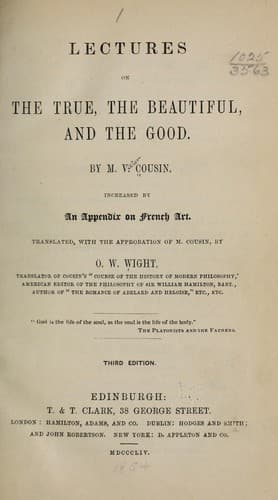
Lectures on the true, the beautiful and the good — John Shaqi
Lectures on the true, the beautiful and the goodCousin, Victor
Philosophy
Lectures on the true, the beautiful and the good
Cousin, Victor
Aesthetics; Ethics; Truth
If absolute truths are beyond man who perceives them, once more, where
are they, then? A peripatetic would respond--In nature. Is it, in fact,
necessary to seek for them any other subject than the beings themselves
which they govern? What are the laws of nature, except certain
properties which our mind disengages from the beings and phenomena in
which they are met, in order to consider them apart? Mathematical
principles are nothing more. For example, the axiom thus expressed--The
whole is greater than any of its parts, is true of any whole and part
whatever. The principle of contradiction, considered in its logical
title, as the condition of all our judgments, of all our reasonings,
constitutes a part of the essence of all being, and no being can exist
without containing it. The universal exists, says Aristotle, but it does
not exist apart from particular beings.[44]
This theory which considers universals as having their basis in things,
is a progress towards the pure conceptualism which we have in the
beginning indicated and shunned. Aristotle is much more of a realist
than Abelard and Kant. He is quite right in maintaining that universals
are in particular things, for particular things could not be without
universals; universals give to them their fixity, even for a day, and
their unity. But from the fact that universals are in particular beings,
is it necessary to conclude that they, wholly and exclusively, reside
there, and that they have no other reality than that of the objects to
which they are applied? It is the same with principles of which
universals are the constitutive elements. It is, it is true, in the
particular fact, of a particular cause producing a particular event,
that is given us the universal principle of causality; but this
principle is much more extensive than the facts, for it is applied, not
only to this fact, but to a thousand others. The particular fact
contains the principle, but it does not wholly contain it, and, far from
giving the basis of the principle, it is based upon it. As much may be
said of other principles.
Perhaps it will be replied that, if a principle is certainly more
extensive than such a fact, or such a being, it is not more extensive
than all facts and all beings, and that nature, considered as a whole,
can explain that which each particular being does not explain. But
nature, in its totality, is still only a finite and contingent thing,
whilst the principles to be explained have a necessary and infinite
bearing. The idea of the infinite can come neither from any particular
being, nor from the whole of beings. Entire nature will not furnish us
the idea of perfection, for all the beings of nature are imperfect.
Absolute principles govern, then, all facts and all beings, they do not
spring from them.
Public-domain text, read in full here on John Shaqi.
Reviews
Reviews
No reviews yet
Be the first to share your thoughts on this work.
Join the Discussion
Join the discussion
Sign in to leave a comment or review.
Sign InorCreate an account