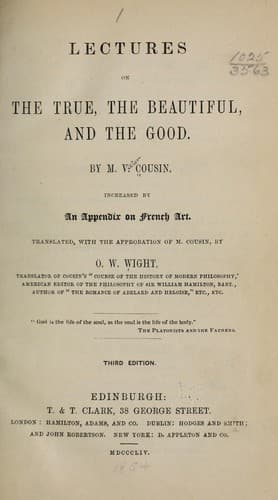
Lectures on the true, the beautiful and the goodCousin, Victor
Philosophy
Lectures on the true, the beautiful and the good
Cousin, Victor
Aesthetics; Ethics; Truth
Will it be necessary to come to the opinion, then, that absolute truths,
being explicable neither by humanity nor by nature, subsist by
themselves, and are to themselves their own foundation and their own
subject?
But this opinion contains still more absurdities than the preceding;
for, I ask, what are truths, absolute or contingent, that exist by
themselves, out of things in which they are found, and out of the
intelligence that conceives them? Truth is, then, only a realized
abstraction. There are no quintessential metaphysics which can prevail
against good sense; and if such is the Platonic theory of ideas,
Aristotle is right in his opposition to it. But such a theory is only a
chimera that Aristotle created for the pleasure of combating it.
Let us hasten to remove absolute truths from this ambiguous and
equivocal state. And how? By applying to them a principle which should
now be familiar to you. Yes, truth necessarily appeals to something
beyond itself. As every phenomenon has its subject of inherence, as our
faculties, our thoughts, our volitions, our sensations, exist only in a
being which is ourselves, so truth supposes a being in which it resides,
and absolute truths suppose a being absolute as themselves, wherein they
have their final foundation. We come thus to something absolute, which
is no longer suspended in the vagueness of abstraction, but is a being
substantially existing. This being, absolute and necessary, since it is
the subject of necessary and absolute truths, this being which is at the
foundation of truth as its very essence, in a single word, is called
_God_.[45]
This theory, which conducts from absolute truth to absolute being, is
not new in the history of philosophy: it goes back to Plato.
Plato,[46] in searching for the principles of knowledge clearly saw,
with Socrates his master, that the least definition, without which there
can be no precise knowledge, supposes something universal and one, which
does not come within the reach of the senses, which reason alone can
discover; this something universal and one he called _Idea_.
Ideas, which possess universality and unity, do not come from material,
changing, and mobile things, to which they are applied, and which render
them intelligible. On the other hand, it is not the human mind that
constitutes ideas; for man is not the measure of truth.
Plato calls Ideas veritable beings, [Greek: ta ontos onta], since they
alone communicate to sensible things and to human cognitions their truth
and their unity. But does it follow that Plato gives to Ideas a
substantial existence, that he makes of them beings properly so called?
It is important that no cloud should be left on this fundamental point
of the Platonic theory.
Public-domain text, read in full here on John Shaqi.
Reviews
Reviews
No reviews yet
Be the first to share your thoughts on this work.
Join the Discussion
Join the discussion
Sign in to leave a comment or review.
Sign InorCreate an account