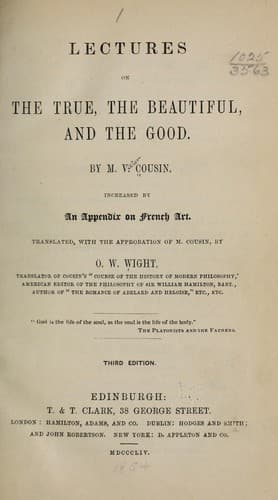
Lectures on the true, the beautiful and the goodCousin, Victor
Philosophy
Lectures on the true, the beautiful and the good
Cousin, Victor
Aesthetics; Ethics; Truth
Part i., chap. lii. "Oh! how great is the mind of man! It bears in
itself what astonishes itself and infinitely surpasses itself. Its ideas
are universal, eternal, and immutable.... The idea of the infinite is
in me as well as that of lines, numbers, and circles....--Chap. liv.
Besides this idea of the infinite, I have also universal and immutable
notions, which are the rule of all my judgments. I can judge of nothing
except by consulting them, and it is not in my power to judge against
what they represent to me. My thoughts, far from being able to correct
this rule, are themselves corrected in spite of me by this superior
rule, and they are irresistibly adjusted to its decision. Whatever
effort of mind I may make, I can never succeed in doubting that two and
two are four; that the whole is not greater than any of its parts; that
the centre of a perfect circle is not equidistant from all points of the
circumference. I am not at liberty to deny these propositions; and if I
deny these truths, or others similar to them, I have in me something
that is above me, that forces me to the conclusion. This fixed and
immutable rule is so internal and so intimate that I am inclined to take
it for myself; but it is above me since it corrects me, redresses me,
and puts me in defiance against myself, and reminds me of my impotence.
It is something that suddenly inspires me, provided I listen to it, and
I am never deceived except in not listening to it.... This internal rule
is what I call my reason....--Chap. lv. In truth my reason is in me; for
I must continually enter into myself in order to find it. But the higher
reason which corrects me when necessary, which I consult, exists not by
me, and makes no part of me. This rule is perfect and immutable; I am
changing and imperfect. When I am deceived, it does not lose its
integrity. When I am undeceived, it is not this that returns to its end:
it is this which, without ever having deviated, has the authority over
me to remind me of my error, and to make me return. It is a master
within, which makes me keep silent, which makes me speak, which makes me
believe, which makes me doubt, which makes me acknowledge my errors or
confirm my judgments. Listening to it, I am instructed; listening to
myself, I err. This master is everywhere, and its voice makes itself
heard, from end to end of the universe, in all men as well as in
me....--Chap. lvi.... That which appears the most in us and seems to be
the foundation of ourselves, I mean our reason, is that which is least
of all our own, which we are constrained to believe to be especially
borrowed. We receive without cessation, and at all moments, a reason
superior to us, as we breathe without cessation the air, which is a
foreign body....--Chap. lvii. The internal and universal master always
and everywhere speaks the same truths. We are not this master. It is
true that we often speak without it, and more loftily than it. But we
Public-domain text, read in full here on John Shaqi.
Reviews
Reviews
No reviews yet
Be the first to share your thoughts on this work.
Elsewhere in the archive
Join the Discussion
Join the discussion
Sign in to leave a comment or review.
Sign InorCreate an account