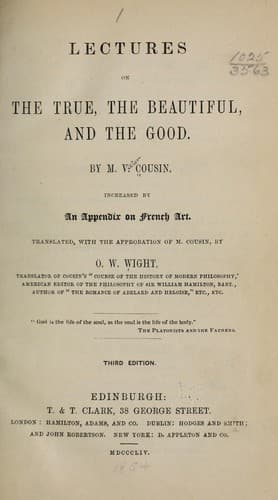
Lectures on the true, the beautiful and the goodCousin, Victor
Philosophy
Lectures on the true, the beautiful and the good
Cousin, Victor
Aesthetics; Ethics; Truth
Among the French writers, Malebranche, perhaps, reminds us with the
least disadvantage, although very imperfectly still, of the manner of
Plato: he sometimes expresses its elevation and grace; but he is far
from possessing the Socratic good sense, and, it must be confessed, no
one has clouded more the theory of ideas by exaggerations of every kind
which he has mingled with them.[59] Instead of establishing that there
is in the human reason, wholly personal as it is by its intimate
relation with our other faculties, something also which is not personal,
something universal which permits it to elevate itself to universal
truths, Malebranche does not hesitate to absolutely confound the reason
that is in us with the divine reason itself. Moreover, according to
Malebranche, we do not directly know particular things, sensible
objects; we know them only by ideas; it is the intelligible extension
and not the material extension that we immediately perceive; in vision
the proper object of the mind is the universal, the idea; and as the
idea is in God, it is in God that we see all things. We can understand
how well-formed minds must have been shocked by such a theory; but it is
not just to confound Plato with his brilliant and unfaithful disciple.
In Plato, sensibility directly attains sensible things; it makes them
known to us as they are, that is to say, as very imperfect and
undergoing perpetual change, which renders the knowledge that we have of
them almost unworthy of the name of knowledge. It is reason, different
in us from sensibility, which, above sensible objects, discovers to us
the universal, the idea, and gives a knowledge solid and durable. Having
once attained ideas, we have reached God himself, in whom they have
their foundation, who finishes and consummates true knowledge. But we
have no need of God, nor of ideas, in order to perceive sensible
objects, which are defective and changing; for this our senses are
sufficient. Reason is distinct from the senses; it transcends the
imperfect knowledge of what they are capable; it attains the universal,
because it possesses something universal itself; it participates in the
divine reason, but it is not the divine reason; it is enlightened by it,
it comes from it,--it is not it.
Fenelon is inspired at once by Malebranche and Descartes in the
treatise, _de l'Existence de Dieu_. The second part is entirely
Cartesian in method, in the order and sequence of the proofs.
Nevertheless, Malebranche also appears there, especially in the fourth
chapter, on the nature of ideas, and he predominates in all the
metaphysical portions of the first part. After the explanations which we
have given, it will not be difficult for you to discern what is true and
what is at times excessive in the passages which follow:[60]
Public-domain text, read in full here on John Shaqi.
Reviews
Reviews
No reviews yet
Be the first to share your thoughts on this work.
Elsewhere in the archive
Join the Discussion
Join the discussion
Sign in to leave a comment or review.
Sign InorCreate an account