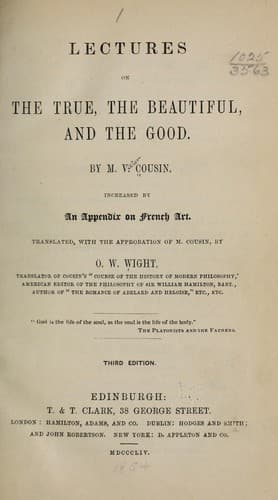
Lectures on the true, the beautiful and the goodCousin, Victor
Philosophy
Lectures on the true, the beautiful and the good
Cousin, Victor
Aesthetics; Ethics; Truth
Chap. iv., sect. 49. "... My ideas are myself; for they are my
reason.... My ideas, and the basis of myself, or of my mind, appear but
the same thing. On the other hand, my mind is changing, uncertain,
ignorant, subject to error, precipitate in its judgments, accustomed to
believe what it does not clearly understand, and to judge without having
sufficiently consulted its ideas, which are by themselves certain and
immutable. My ideas, then, are not myself, and I am not my ideas. What
shall I believe, then, they can be?... What then! are my ideas God?
They are superior to my mind, since they rectify and correct it; they
have the character of the Divinity, for they are universal and immutable
like God; they really subsist, according to a principle that we have
already established: nothing exists so really as that which is universal
and immutable. If that which is changing, transitory, and derived, truly
exists, much more does that which cannot change, and is necessary. It is
then necessary to find in nature something existing and real, that is,
my ideas, something that is within me, and is not myself, that is
superior to me, that is in me even when I am not thinking of it, with
which I believe myself to be alone, as though I were only with myself,
in fine, that is more present to me, and more intimate than my own
foundation. I know not what this something, so admirable, so familiar,
so unknown, can be, except God."
Let us now hear the most solid, the most authoritative of the Christian
doctors of the seventeenth century--let us hear Bossuet in his _Logic_,
and in the _Treatise on the Knowledge of God and Self_.[63]
Bossuet may be said to have had three masters in philosophy--St.
Augustine, St. Thomas, and Descartes. He had been taught at the college
of Navarre the doctrine of St. Thomas, that is to say, a modified
peripateticism; at the same time he was nourished by the reading of St.
Augustine, and out of the schools he found spread abroad the philosophy
of Descartes. He adopted it, and had no difficulty in reconciling it
with that of St. Augustine, while, upon more than one point, it
corroborated the doctrine of St. Thomas. Bossuet invented nothing in
philosophy; he received every thing, but every thing united and
purified, thanks to that supreme good sense which in him is a quality
predominating over force, grandeur, and eloquence.[64] In the passages
which I am about to exhibit to you, which I hope you will impress upon
your memories, you will not find the grace of Malebranche, the
exhaustless abundance of Fenelon; you will find what is better than
either, to wit, clearness and precision--all the rest in him is in some
sort an addition to these.
Public-domain text, read in full here on John Shaqi.
Reviews
Reviews
No reviews yet
Be the first to share your thoughts on this work.
Elsewhere in the archive
Join the Discussion
Join the discussion
Sign in to leave a comment or review.
Sign InorCreate an account