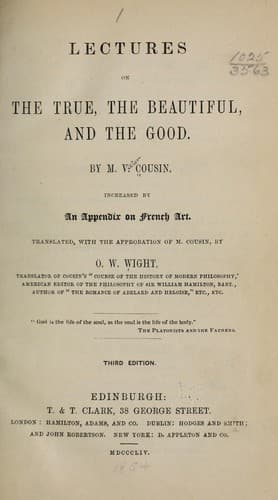
Lectures on the true, the beautiful and the goodCousin, Victor
Philosophy
Lectures on the true, the beautiful and the good
Cousin, Victor
Aesthetics; Ethics; Truth
Fenelon disengages badly enough the process which conducts from ideas,
from universal and necessary truths, to God. Bossuet renders to himself
a strict account of this process, and marks it with force; it is the
principle that we have invoked, that which concludes from attributes in
a subject, from qualities in a being, from laws in a legislator, from
eternal verities in an eternal mind that comprehends them and eternally
possesses them. Bossuet cites St. Augustine, cites Plato himself,
interprets him and defends him in advance against those who would make
Platonic ideas beings subsisting by themselves, whilst they really exist
only in the mind of God.
_Logic_, book i., chap. xxxvi. "When I consider a rectilineal triangle
as a figure bounded by three straight lines, and having three angles
equal to two right angles, neither more nor less; and when I pass from
this to an equilateral triangle with its three sides and its three
angles equal, whence it follows, that I consider each angle of this
triangle as less than a right angle; and when I come again to consider a
right-angled triangle, and what I clearly see in this idea, in
connection with the preceding ideas, that the two angles of this
triangle are necessarily acute, and that these two acute angles are
exactly equal to one right angle, neither more nor less--I see nothing
contingent and mutable, and consequently, the ideas that represent to me
these truths are eternal. Were there not in nature a single equilateral
or right-angled triangle, or any triangle whatever, every thing that I
have just considered would remain always true and indubitable. In fact,
I am not sure of having ever seen an equilateral or rectilineal
triangle. Neither the rule nor the dividers could assure me that any
human hand, however skilful, could ever make a line exactly straight, or
sides and angles perfectly equal to each other. In strictness, we should
only need a microscope, in order, not to understand, but to see at a
glance, that the lines which we trace deviate from straightness, and
differ in length. We have never seen, then, any but imperfect images of
equilateral, rectilineal, or isosceles triangles, since they neither
exist in nature, nor can be constructed by art. Nevertheless, what we
see of the nature and the properties of a triangle, independently of
every existing triangle, is certain and indubitable. Place an
understanding in any given time, or at any point in eternity, thus to
speak, and it will see these truths equally manifest; they are,
therefore, eternal. Since the understanding does not give being to
truth, but is only employed in perceiving truth, it follows, that were
every created understanding destroyed, these truths would immutably
subsist...."
Chap. xxxvii. "Since there is nothing eternal, immutable, independent,
but God alone, we must conclude that these truths do not subsist in
themselves, but in God alone, and in his eternal ideas, which are
nothing else than himself.
Public-domain text, read in full here on John Shaqi.
Reviews
Reviews
No reviews yet
Be the first to share your thoughts on this work.
Elsewhere in the archive
Join the Discussion
Join the discussion
Sign in to leave a comment or review.
Sign InorCreate an account