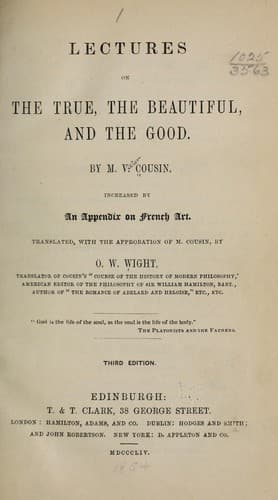
Lectures on the true, the beautiful and the goodCousin, Victor
Philosophy
Lectures on the true, the beautiful and the good
Cousin, Victor
Aesthetics; Ethics; Truth
"Truth must somewhere be very perfectly understood, and man is to
himself an indubitable proof of this. For, whether he considers himself
or extends his vision to the beings that surround him, he sees every
thing subjected to certain laws, and to immutable rules of truth. He
sees that he understands these laws, at least in part,--he who has
neither made himself, nor any part of the universe, however small, and
he sees that nothing could have been made had not these laws been
elsewhere perfectly understood; and he sees that it is necessary to
recognize an eternal wisdom wherein all law, all order, all proportion,
have their primitive reason. For it is absurd to suppose that there is
so much sequence in truths, so much proportion in things, so much
economy in their arrangement, that is to say, in the world, and that
this sequence, this proportion, this economy, should nowhere be
understood:--and man, who has made nothing, veritably knowing these
things, although not fully knowing them, must judge that there is some
one who knows them in their perfection, and that this is he who has made
all things...."
Sect. 6 is wholly Cartesian. Bossuet there demonstrates that the soul
knows by the imperfection of its own intelligence that there is
elsewhere a perfect intelligence.
In sect. 9, Bossuet elucidates anew the relation of truth to God.
"Whence comes to my intelligence this impression, so pure, of truth?
Whence come to it those immutable rules that govern reasoning, that form
manners, by which it discovers the secret proportions of figures and of
movements? Whence come to it, in a word, those eternal truths which I
have considered so much? Do the triangles, the squares, the circles,
that I rudely trace on paper, impress upon my mind their proportions and
their relations? Or are there others whose perfect trueness produces
this effect? Where have I seen these circles and these triangles so
true,--I who am not sure of ever having seen a perfectly regular figure,
and, nevertheless, understand this regularity so perfectly? Are there
somewhere, either in the world or out of the world, triangles or circles
existing with this perfect regularity, whereby it could be impressed
upon my mind? And do these rules of reasoning and conduct also exist in
some place, whence they communicate to me their immutable truth? Or,
indeed, is it not rather he who has everywhere extended measure,
proportion, truth itself, that impresses on my mind the certain idea of
them?... It is, then, necessary to understand that the soul, made in the
image of God, capable of understanding truth, which is God himself,
actually turns towards its original, that is to say, towards God, where
the truth appears to it as soon as God wills to make the truth appear to
it.... It is an astonishing thing that man understands so many truths,
without understanding at the same time that all truth comes from God,
that it is in God, that it is God himself.... It is certain that God is
Public-domain text, read in full here on John Shaqi.
Reviews
Reviews
No reviews yet
Be the first to share your thoughts on this work.
Elsewhere in the archive
Join the Discussion
Join the discussion
Sign in to leave a comment or review.
Sign InorCreate an account