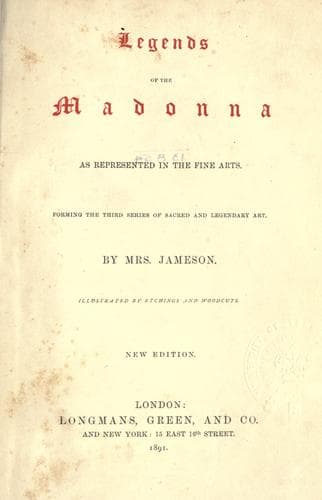
Legends of the Madonna as Represented in the Fine ArtsJameson, Mrs. (Anna)
Religion
Legends of the Madonna as Represented in the Fine Arts
Jameson, Mrs. (Anna)
Christian saints in art; Mary, Blessed Virgin, Saint -- Art; Mary, Blessed Virgin, Saint -- Legends
The Virgin, when supported on each side by St. Peter and St. Paul,
must be understood to represent the personified Church between her
two great founders and defenders; and this relation is expressed,
in a very poetical manner, when St. Peter, kneeling, receives the
allegorical keys from the hand of the infant Saviour. There are some
curious and beautiful instances of this combination of a significant
action with the utmost solemnity of treatment; for example, in
that very extraordinary Franciscan altar-piece, by Carlo Crivelli,
lately purchased by Lord Ward, where St. Peter, having deposited his
papal tiara at the foot of the throne, kneeling receives the great
symbolical keys. And again, in a fine picture by Andrea Meldula, where
the Virgin and Child are enthroned, and the infant Christ delivers
the keys to Peter, who stands, but with a most reverential air; on the
other side of the throne is St. Paul with his book and the sword held
upright. There are also two attendant angels. On the border of the
mantle of the Virgin is inscribed "_Ave Maria gratia plena_."[1]
[Footnote 1: In the collection of Mr. Bromley, of Wootton. This
picture is otherwise remarkable as the only authenticated work of a
very rare painter. It bears his signature, and the style indicates the
end of the fifteenth century as the probable date.]
I do not recollect any instance in which the four evangelists as such,
or the twelve apostles in their collective character, wait round the
throne of the Virgin and Child, though one or more of the evangelists
and one or more of the apostles perpetually occur.
The Virgin between St. John the Baptist and St. John the Evangelist,
is also a very significant and beautiful combination, and one very
frequently met with. Though both these saints were as children
contemporary with the child Christ, and so represented in the Holy
Families, in these solemn ideal groups they are always men. The first
St. John expresses regeneration by the rite of baptism the second St.
John, distinguished as _Theologus_, "the Divine," stands with his
sacramental cup, expressing regeneration by faith. The former was the
precursor of the Saviour, the first who proclaimed him to the world as
such; the latter beheld the vision in Patmos, of the Woman in travail
pursued by the dragon, which is interpreted in reference to the
Virgin and her Child. The group thus brought into relation is full
of meaning, and, from the variety and contrast of character, full of
poetical and artistic capabilities. St. John the Baptist is usually
a man about thirty, with wild shaggy hair and meagre form, so draped
that his vest of camel's hair is always visible; he holds his reed
cross. St. John the Evangelist is generally the young and graceful
disciple; but in some instances he is the venerable seer of Patmos,
"Whose beard descending sweeps his aged breast."
Public-domain text, read in full here on John Shaqi.
Reviews
Reviews
No reviews yet
Be the first to share your thoughts on this work.
Elsewhere in the archive
Join the Discussion
Join the discussion
Sign in to leave a comment or review.
Sign InorCreate an account