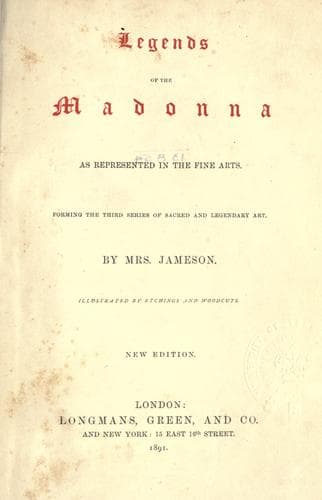
Legends of the Madonna as Represented in the Fine ArtsJameson, Mrs. (Anna)
Religion
Legends of the Madonna as Represented in the Fine Arts
Jameson, Mrs. (Anna)
Christian saints in art; Mary, Blessed Virgin, Saint -- Art; Mary, Blessed Virgin, Saint -- Legends
in 1511, when Raphael was in his twenty-eighth year. Conti died
in 1512, and in 1565 his grandniece, Suora Anna Conti, obtained
permission to remove it to her convent at Foligno, whence it was
carried off by the French in 1792. Since the restoration of the works
of art in Italy, in 1815, it has been placed among the treasures of
the Vatican.
* * * * *
2. Another perfect specimen of a votive picture of this kind, in a
very different style, I saw in the museum at Rouen, attributed there
to Van Eyck. It is, probably, a fine work by a later master of the
school, perhaps Hemmelinck. In the centre, the Virgin is enthroned;
the Child, seated on her knee, holds a bunch of grapes, symbol of
the eucharist. On the right of the Virgin is St. Apollonia; then two
lovely angels in white raiment, with lutes in their hands; and then
a female head, seen looking from behind, evidently a family portrait.
More in front, St. Agnes, splendidly dressed in green and sable, her
lamb at her feet, turns with a questioning air to St. Catherine,
who, in queenly garb of crimson and ermine seems to consult her book.
Behind her another member of the family, a man with a very fine face;
and more in front St. Dorothea, with a charming expression of modesty,
looks down on her basket of roses. On the left of the Virgin is St.
Agatha; then two angels in white with viols; then St. Cecilia; and
near her a female head, another family portrait; next St. Barbara
wearing a beautiful head-dress, in front of which is worked her tower,
framed like an ornamental jewel in gold and pearls; she has a missal
in her lap. St. Lucia next appears; then another female portrait.
All the heads are about one fourth of the size of life. I stood in
admiration before this picture--such miraculous finish in all the
details, such life, such spirit, such delicacy in the heads and hands,
such brilliant colour in the draperies! Of its history I could learn
nothing, nor what family had thus introduced themselves into celestial
companionship. The portraits seemed to me to represent a father, a
mother, and two daughters.
* * * * *
I must mention some other instances of votive Madonnas, interesting
either from their beauty or their singularity.
3. Réné, Duke of Anjou, and King of Sicily and Jerusalem, the father
of our Amazonian queen, Margaret of Anjou, dedicated, in the church
of the Carmelites, at Aix, the capital of his dominions, a votive
picture, which is still to be seen there. It is not only a monument
of his piety, but of his skill; for, according to the tradition of the
country, he painted it himself. The good King Réné was no contemptible
artist; but though he may have suggested the subject, the hand of a
practised and accomplished painter is too apparent for us to suppose
it his own work.
Public-domain text, read in full here on John Shaqi.
Reviews
Reviews
No reviews yet
Be the first to share your thoughts on this work.
Elsewhere in the archive
Join the Discussion
Join the discussion
Sign in to leave a comment or review.
Sign InorCreate an account