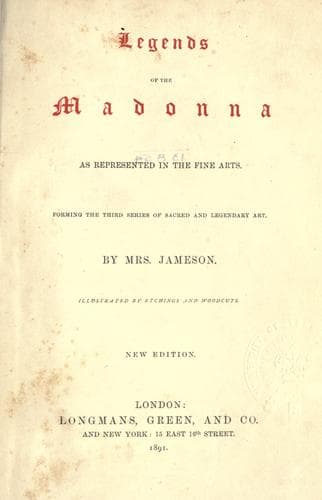
Legends of the Madonna as Represented in the Fine ArtsJameson, Mrs. (Anna)
Religion
Legends of the Madonna as Represented in the Fine Arts
Jameson, Mrs. (Anna)
Christian saints in art; Mary, Blessed Virgin, Saint -- Art; Mary, Blessed Virgin, Saint -- Legends
Where the Children are merely embracing each other, or sporting at
the feet of the Virgin, or playing with the cross, or with a bird, or
with the lamb, or with flowers, we might call the treatment domestic
or poetical; but where St. John is taking the cross from the hand of
Christ, it is clear, from the perpetual repetition of the theme, that
it is intended to express a religious allegory. It is the mission of
St. John as Baptist and Prophet. He receives the symbol of faith ere
he goes forth to preach and to convert, or as it has been interpreted,
he, in the sense used by our Lord, "takes up the cross of our Lord."
The first is, I think, the meaning when the cross is enwreathed with
the _Ecce Agnus Dei_; the latter, when it is a simple cross.
In Raphael's "Madonna della Famiglia Alva," (now in the Imp. Gal., St.
Petersburg), and in his Madonna of the Vienna Gallery, Christ gives
the cross to St. John. In a picture of the Lionardo school in the
Louvre we have the same action; and again in a graceful group by
Guido, which, in the engraving, bears this inscription, "_Qui non
accipit crucem suam non est me dignus_." (Matt. x. 38.) This, of
course, fixes the signification.
Another, and, as I think, a wholly fanciful interpretation, has been
given to this favourite group by Treck and by Monckton Milnes. The
Children contend for the cross. The little St. John begs to have it.
"Give me the cross, I pray you, dearest Jesus.
O if you knew how much I wish to have it,
You would not hold it in your hand so tightly.
Something has told me, something in my breast here,
Which I am sure is true, that if you keep it,
If you will let no other take it from you,
Terrible things I cannot bear to think of
Must fall upon you. Show me that you love me:
Am I not here to be your little servant,
Follow your steps, and wait upon your wishes?"
But Christ refuses to yield the terrible plaything, and claims his
privilege to be the elder "in the heritage of pain."
In a picture by Carlo Maratti, I think this action is evident--Christ
takes the cross, and St. John yields it with reluctance.
A beautiful version of the Mater Amabilis is the MADRE PIA, where the
Virgin in her divine Infant acknowledges and adores the Godhead. We
must be careful to distinguish this subject from the Nativity, for
it is common, in the scene of the birth of the Saviour at Bethlehem,
to represent the Virgin adoring her new-born Child. The presence of
Joseph--the ruined shed or manger--the ox and ass,--these express the
_event_. But in the MADRE PIA properly so called, the locality, and
the accessories, if any, are purely ideal and poetical, and have
no reference to time or place. The early Florentines, particularly
Lorenzo di Credi, excelled in this charming subject.
Public-domain text, read in full here on John Shaqi.
Reviews
Reviews
No reviews yet
Be the first to share your thoughts on this work.
Elsewhere in the archive
Join the Discussion
Join the discussion
Sign in to leave a comment or review.
Sign InorCreate an account