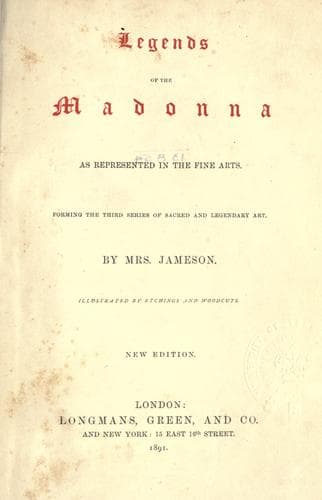
Legends of the Madonna as Represented in the Fine ArtsJameson, Mrs. (Anna)
Religion
Legends of the Madonna as Represented in the Fine Arts
Jameson, Mrs. (Anna)
Christian saints in art; Mary, Blessed Virgin, Saint -- Art; Mary, Blessed Virgin, Saint -- Legends
This, as an artistic subject, is of great consequence, from the beauty
and celebrity of some of the representations, which, however, are
unintelligible without the accompanying legends. And it is worth
remarking, that while the incident is avoided in early Greek art,
it became very popular with the Italian and German painters from the
fourteenth century.
In the East, the prevalence of the monastic spirit, from the fourth
century, had brought marriage into disrepute; by many of the ascetic
writers of the West it was considered almost in the light of a
necessary evil. This idea, that the primal and most sacred ordinance
of God and nature was incompatible with the sanctity and purity
acceptable to God, was the origin of the singular legends of the
Marriage of the Virgin. One sees very clearly that, if possible, it
would have been denied that Mary had ever been married at all; but,
as the testimony of the Gospel was too direct and absolute to be
set aside, it became necessary, in the narrative, to give to this
distasteful marriage the most recondite motives, and in art, to
surround it with the most poetical and even miraculous accessories.
But before we enter on the treatment of the subject, it is necessary
to say a few words on the character of Joseph, wonderfully selected to
be the husband and guardian of the consecrated mother of Christ, and
foster-father of the Redeemer; and so often introduced into all the
pictures which refer to the childhood of our Lord.
From the Gospels we learn nothing of him but that he was of the tribe
of Judah and the lineage of David; that he was a _just_ man; that he
followed the trade of a carpenter, and dwelt in the little city of
Nazareth. We infer from his conduct towards Mary, that he was a mild,
and tender, and pure-hearted, as well as an upright man. Of his age
and personal appearance nothing is said. These are the points on which
the Church has not decided, and on which artists, left to their own
devices, and led by various opinions, have differed considerably.
The very early painters deemed it right to represent Joseph as very
old, almost decrepit with age, and supported by a crutch. According
to some of the monkish authorities, he was a widower, and eighty-four
years old when he was espoused to Mary. On the other hand, it was
argued, that such a marriage would have been quite contrary to the
custom of the Jews; and that to defend Mary, and to provide for her
celestial Offspring, it was necessary that her husband should be a
man of mature age, but still strong and robust, and able to work
at his trade; and thus, with more propriety and better taste, the
later painters have represented him. In the best Italian and Spanish
pictures of the Holy Family, he is a man of about forty or fifty,
with a mild, benevolent countenance, brown hair, and a short, curled
beard: the crutch, or stick, however, is seldom omitted; it became a
conventional attribute.
Public-domain text, read in full here on John Shaqi.
Reviews
Reviews
No reviews yet
Be the first to share your thoughts on this work.
Elsewhere in the archive
Join the Discussion
Join the discussion
Sign in to leave a comment or review.
Sign InorCreate an account