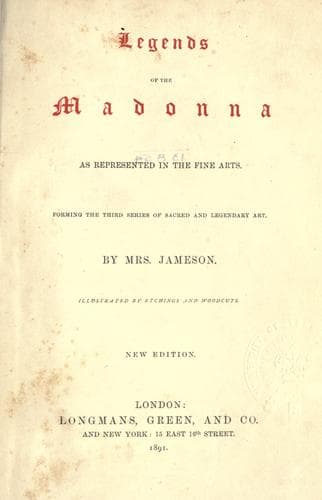
Legends of the Madonna as Represented in the Fine ArtsJameson, Mrs. (Anna)
Religion
Legends of the Madonna as Represented in the Fine Arts
Jameson, Mrs. (Anna)
Christian saints in art; Mary, Blessed Virgin, Saint -- Art; Mary, Blessed Virgin, Saint -- Legends
It appears that this was an accepted religious allegory, as familiar
in the sixteenth century as those of Spenser's "Fairy Queen" or the
"Pilgrim's Progress" are to us. I have since found it frequently
reproduced in the old French and German prints: there is a specimen
in the British Museum; and there is a picture similarly treated in the
Musée at Amiens. I have never seen it in an Italian picture or print;
unless a print after Guido, wherein a beautiful maiden is seated under
a tree, and a unicorn has sought refuge in her lap, be intended to
convey the same far-fetched allegory.
Very common, however, in Italian art, is a less fantastic, but still
wholly poetical version of the Annunciation, representing, in fact,
not the Annunciation, but the Incarnation. Thus, in a picture by
Giovanni Sanzio (the father of Raphael) (Brera, Milan), Mary stands
under a splendid portico; she appears as if just risen from her seat
her hands are meekly folded over her bosom; her head declined. The
angel kneels outside the portico, holding forth his lily; while above,
in the heavens, the Padre Eterno sends forth the Redeemer, who, in
form of the infant Christ bearing his cross, floats downwards towards
the earth, preceded by the mystic Dove. This manner of representing
the Incarnation is strongly disapproved of by the Abbé Méry (v.
Théologie des Peintres), as not only an error, but a heresy: yet it
was frequently repeated in the sixteenth century.
The Annunciation is also a mystery when certain emblems are introduced
conveying a certain signification; as when Mary is seated on a throne,
wearing a radiant crown of mingled gems and flowers, and receives the
message of the angel with all the majesty that could be expressed by
the painter; or is seated, in a garden enclosed by a hedge of roses
(the _Hortus clausus_ or _conclusus_ of the Canticles); or where the
angel holds in his hands the sealed book, as in the famous altar-piece
at Cologne.
In a picture by Simone Memmi, the Virgin seated on a Gothic throne
receives, as the higher and superior being, yet with a shrinking
timidity, the salutation of the angel, who comes as the messenger
of peace, olive-crowned, and bearing a branch of olive in his hand.
(Florence Gal.) This poetical version is very characteristic of the
early Siena school, in which we often find a certain fanciful and
original way of treating well known subjects. Taddeo Bartoli, another
Sienese, and Martin Schoen, the most poetical of the early Germans,
also adopted the olive-symbol; and we find it also in the tabernacle
of King Réné, already described.
Public-domain text, read in full here on John Shaqi.
Reviews
Reviews
No reviews yet
Be the first to share your thoughts on this work.
Elsewhere in the archive
Join the Discussion
Join the discussion
Sign in to leave a comment or review.
Sign InorCreate an account