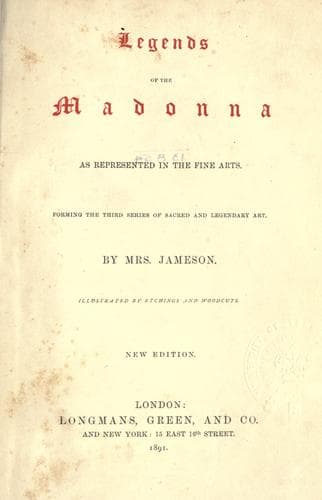
Legends of the Madonna as Represented in the Fine ArtsJameson, Mrs. (Anna)
Religion
Legends of the Madonna as Represented in the Fine Arts
Jameson, Mrs. (Anna)
Christian saints in art; Mary, Blessed Virgin, Saint -- Art; Mary, Blessed Virgin, Saint -- Legends
But, whether walking or flying, Gabriel bears, of course, the
conventional angelic form, that of the human creature, winged,
beautiful, and radiant with eternal youth, yet with a grave and
serious mien, in the later pictures, the drapery given to the angel is
offensively scanty; his sandals, and bare arms, and fluttering robe,
too much _à l'antique_; he comes in the attitude of a flying Mercury,
or a dancer in a ballet. But in the early Italian pictures his dress
is arranged with a kind of solemn propriety: it is that of an acolyte,
white and full, and falling in large folds over his arms, and in
general concealing his feet. In the German pictures, he often wears
the priestly robe, richly embroidered, and clasped in front by a
jewel. His ambrosial curls fall over this cope in "hyacinthine
flow." The wings are essential, and never omitted. They are white, or
many-coloured, eyed like the peacock's train, or bedropped with gold.
He usually bears the lily in his hand, but not always. Sometimes it is
the sceptre, the ancient attribute of a herald; and this has a scroll
around it, with the words, "Ave Maria gratia plena!" The sceptre or
wand is, occasionally surmounted by a cross.
In general, the palm is given to the angel who announces the death of
Mary. In one or two instances only I have seen the palm given to the
angel Gabriel, as in a predella by Angelico; for which, however, the
painter had the authority of Dante, or Dante some authority earlier
still. He says of Gabriel,
"That he bore the _palm_
Down unto Mary when the Son of God
Vouchsafed to clothe him in terrestrial weeds."
The olive-bough has a mystical sense wherever adopted: it is the
symbol of _peace_ on earth. Often the angel bears neither lily, nor
sceptre, nor palm, nor olive. His hands are folded on his bosom; or,
with one hand stretched forth, and the other pointing upwards, he
declares his mission from on high.
In the old Greek pictures, and in the most ancient Italian examples,
the angel stands; as in the picture by Cimabue, wherein the Greek
model is very exactly followed. According to the Roman Catholic
belief, Mary is Queen of heaven, and of angels--the superior being;
consequently, there is propriety in making the angel deliver his
message kneeling: but even according to the Protestant belief the
attitude would not be unbecoming, for the angel, having uttered
his salutation, might well prostrate himself as witness of the
transcending miracle, and beneath the overshadowing presence of
the Holy Spirit.
Public-domain text, read in full here on John Shaqi.
Reviews
Reviews
No reviews yet
Be the first to share your thoughts on this work.
Elsewhere in the archive
Join the Discussion
Join the discussion
Sign in to leave a comment or review.
Sign InorCreate an account