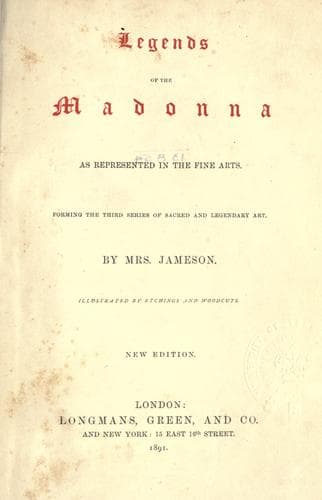
Legends of the Madonna as Represented in the Fine ArtsJameson, Mrs. (Anna)
Religion
Legends of the Madonna as Represented in the Fine Arts
Jameson, Mrs. (Anna)
Christian saints in art; Mary, Blessed Virgin, Saint -- Art; Mary, Blessed Virgin, Saint -- Legends
The number of the figures, the locality and circumstances, vary
greatly. Sometimes we have only the two women, without accessories
of any kind, and nothing interferes with the high solemnity of that
moment in which Elizabeth confesses the mother of her Lord. The better
to express this willing homage, this momentous prophecy, she is often
kneeling. Other figures are frequently introduced, because it could
not be supposed that Mary made the journey from Nazareth to the
dwelling of Zacharias near Jerusalem, a distance of fifty miles,
alone. Whether her husband Joseph accompanied her, is doubtful;
and while many artists have introduced him, others have omitted him
altogether. According to the ancient Greek formula laid down for the
religious painters, Mary is accompanied by a servant or a boy, who
carries a stick across his shoulder, and a basket slung to it. The old
Italians who followed the Byzantine models seldom omit this attendant,
but in some instances (as in the magnificent composition of Michael
Angelo, in the possession of Mr. Bromley, of Wootten) a handmaid
bearing a basket on her head is substituted for the boy. In many
instances Joseph, attired as a traveller, appears behind the Virgin,
and Zacharias, in his priestly turban and costume, behind Elizabeth.
The locality is often an open porch or a garden in front of a house;
and this garden of Zacharias is celebrated in Eastern tradition. It is
related that the blessed Virgin, during her residence with her cousin
Elizabeth, frequently recreated herself by walking in the garden
of Zacharias, while she meditated on the strange and lofty destiny
to which she was appointed; and farther, that happening one day to
touch a certain flower, which grew there, with her most blessed hand,
from being inodorous before, it became from that moment deliciously
fragrant. The garden therefore was a fit place for the meeting.
* * * * *
1. The earliest representation of the Visitation to which I can refer
is a rude but not ungraceful drawing, in the Catacombs at Rome, of two
women embracing. It is not of very high antiquity, perhaps the seventh
or eighth century, but there can be so doubt about the subject.
(Cemetery of Julius, v. Bosio, Roma sotterana.)
2. Cimabue has followed the Greek formula, and his simple group
appears to me to have great feeling and simplicity.
Public-domain text, read in full here on John Shaqi.
Reviews
Reviews
No reviews yet
Be the first to share your thoughts on this work.
Elsewhere in the archive
Join the Discussion
Join the discussion
Sign in to leave a comment or review.
Sign InorCreate an account