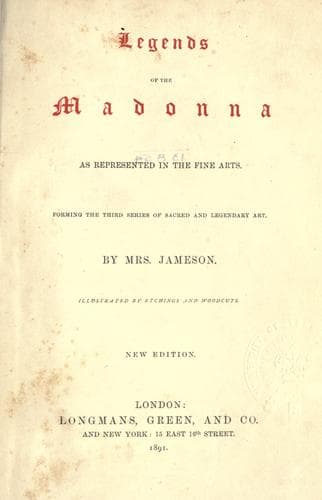
Legends of the Madonna as Represented in the Fine ArtsJameson, Mrs. (Anna)
Religion
Legends of the Madonna as Represented in the Fine Arts
Jameson, Mrs. (Anna)
Christian saints in art; Mary, Blessed Virgin, Saint -- Art; Mary, Blessed Virgin, Saint -- Legends
In a drawing by Raphael, the Child slumbers, and Joseph raises the
coverlid, to show him to a shepherd. We have the same idea in several
other instances. In a graceful composition by Titian, it is the Virgin
Mother who raises the veil from the face of the sleeping Child.
* * * * *
From the number of figures and accessories, the Nativity thus treated
as an historical subject becomes capable of almost endless variety;
but as it is one not to be mistaken, and has a universal meaning and
interest, I may now leave it to the fancy and discrimination of the
observer.
THE ADORATION OF THE MAGI.
_Ital._ L' Adorazione de' Magi. L' Epifania. _Fr._ L'Adoration des
Rois Mages. _Ger._ Die Anbetung der Weisen aus dem Morgenland. Die
heiligen drei Könige. Jan. 6.
This, the most extraordinary incident in the early life of our
Saviour, rests on the authority of one evangelist only. It is
related by St. Matthew so briefly, as to present many historical and
philosophical difficulties. I must give some idea of the manner in
which these difficulties were elucidated by the early commentators,
and of the notions which prevailed in the middle ages relative to the
country of the Three Kings, before it will be possible to understand
or to appreciate the subject as it has been set before us in every
style of art, in every form, in every material, from the third century
to the present time.
In the first place, who were these Magi, or these kings, as they are
sometimes styled? "To suppose," says the antique legend, "that they
were called Magi because they were addicted to magic, or exercised
unholy or forbidden arts, would be, heaven save us! a rank heresy."
No! Magi, in the Persian tongue, signifies "wise men." They were,
in their own country, kings or princes, as it is averred by all the
ancient fathers; and we are not to be offended at the assertion,
that they were at once princes and _wise_ men,--"Car à l'usage de ce
temps-là les princes et les rois etoient très sages!"[1]
[Footnote 1: Quoted literally from the legend in the old French
version of the _Flos Sanctorum_.]
They came from the eastern country, but from what country is not
said; whether from the land of the Arabians, or the Chaldeans, or the
Persians, or the Parthians.
Public-domain text, read in full here on John Shaqi.
Reviews
Reviews
No reviews yet
Be the first to share your thoughts on this work.
Elsewhere in the archive
Join the Discussion
Join the discussion
Sign in to leave a comment or review.
Sign InorCreate an account