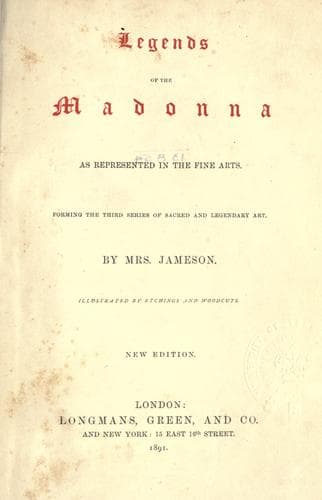
Legends of the Madonna as Represented in the Fine ArtsJameson, Mrs. (Anna)
Religion
Legends of the Madonna as Represented in the Fine Arts
Jameson, Mrs. (Anna)
Christian saints in art; Mary, Blessed Virgin, Saint -- Art; Mary, Blessed Virgin, Saint -- Legends
Immediately on the revival of art we find the Adoration of the Kings
treated in the Byzantine style, with few accessories. Very soon,
however, in the early Florentine school, the artists began to avail
themselves of that picturesque variety of groups of which the story
admitted.
In the legends of the fourteenth century, the kings had become
distinct personages, under the names of Caspar (or Jasper), Melchior,
and Balthasar: the first being always a very aged man, with a long
white beard; the second, a middle-aged man; the third is young, and
frequently he is a Moor or Negro, to express the King of Ethiopia
or Nubia, and also to indicate that when the Gentiles were called
to salvation, all the continents and races of the earth, of whatever
complexion, were included. The difference of ages is indicated in
the Greek formula; but the difference of complexion is a modern
innovation, and more frequently found in the German than in the
Italian schools. In the old legend of the Three Kings, as inserted in
Wright's "Chester Mysteries," Jasper, or Caspar, is King of Tarsus,
the land of merchants; he makes the offering of gold. Melchior, the
King of Arabia and Nubia, offers frankincense; and Balthasar, King of
Saba,--"the land of spices and all manner of precious gums,"--offers
myrrh.[1]
[Footnote 1: The names of the Three Kings appear for the first time in
a piece of rude sculpture over the door of Sant' Andrea at Pistoia, to
which is assigned the date 1166. (_Vide_ D'Agincourt, _Scultura_, pl.
xxvii.)]
It is very usual to find, in the Adoration of the Magi, the angelic
announcement to the shepherds introduced into the background; or, more
poetically, the Magi approaching on one side, and the shepherds on the
other. The intention is then to express a double signification; it is
at once the manifestation to the Jews, and the manifestation to the
Gentiles.
The attitude of the Child varies. In the best pictures he raises his
little hand in benediction. The objection that he was then only an
infant of a few days old is futile: for he was from his birth the
CHRIST. It is also in accordance with the beautiful and significant
legend which describes him as dispensing to the old wise men the
spiritual blessings of love, meekness, and perfect faith, in return
for their gifts and their homage. It appears to me bad taste,
verging on profanity, to represent him plunging his little hand into
the coffer of gold, or eagerly grasping one of the gold pieces.
Neither should he be wrapped up in swaddling clothes, nor in any
way a subordinate figure in the group; for it is the Epiphany, the
Manifestation of a divine humanity to Jews and Gentiles, which is
to be expressed; and there is meaning as well as beauty in those
compositions which represent the Virgin at lifting a veil and showing
him to the Wise Man.
Public-domain text, read in full here on John Shaqi.
Reviews
Reviews
No reviews yet
Be the first to share your thoughts on this work.
Elsewhere in the archive
Join the Discussion
Join the discussion
Sign in to leave a comment or review.
Sign InorCreate an account