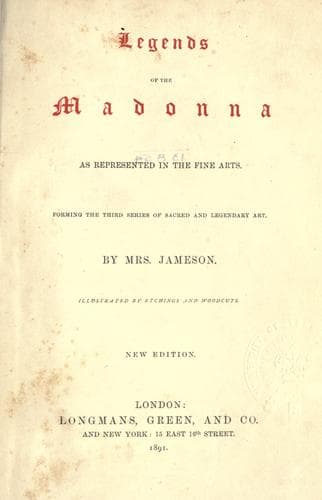
Legends of the Madonna as Represented in the Fine ArtsJameson, Mrs. (Anna)
Religion
Legends of the Madonna as Represented in the Fine Arts
Jameson, Mrs. (Anna)
Christian saints in art; Mary, Blessed Virgin, Saint -- Art; Mary, Blessed Virgin, Saint -- Legends
A very remarkable altar-piece, by Jean Van Eyck, represents the
worship of the Magi. In the centre, Mary and her Child are seated
within a ruined temple; the eldest of the three Kings kneeling, does
homage by kissing the hand of the Child: it is the portrait of Philip
the Good, Duke of Burgundy. The second, prostrate behind him with a
golden beaker in his hand, is supposed to be one of the great officers
of his household. The third King exhibits the characteristic portrait
of Charles the Bold; there is no expression of humility or devotion
either in his countenance or attitude; he stands upright, with a lofty
disdainful air, as if he were yet unresolved whether he would kneel
or not. On the right of the Virgin, a little in the foreground, stands
Joseph in a plain red dress, holding his hat in his hand, and looking
with as air of simple astonishment at his magnificent guests. All the
accessories in this picture, the gold and silver vessels, the dresses
of the three Kings sparking with jewels and pearls, the velvets,
silks, and costly furs, are painted with the most exquisite finish and
delicacy, and exhibit to us the riches of the court of Burgundy, in
which Van Eyck then resided. (Munich Gal, 45.)
In Raphael's composition, the worshippers wear the classical, not the
oriental costume; but an elephant with a monkey on his back is seen
in the distance, which at once reminds us of the far East. (Rome,
Vatican.)
Ghirlandajo frequently painted the Adoration of the Magi, and shows
in his management of the accessories much taste and symmetry. In one
of his compositions, the shed forms a canopy in the centre; two of
the Kings kneel in front. The country of the Ethiopian King is not
expressed by making him of a black complexion, but by giving him
a Negro page, who is in the act of removing his master's crown.
(Florence, Pitti Pal.)
A very complete example of artificial and elaborate composition may be
found in the drawing by Baldassare Peruzzi in our National Gallery.
It contains at least fifty figures; in the centre, a magnificent
architectural design; and wonderful studies of perspective to the
right and left, in the long lines of receding groups. On the whole,
it is a most skilful piece of work; but to my taste much like a
theatrical decoration,--pompous without being animated.
Public-domain text, read in full here on John Shaqi.
Reviews
Reviews
No reviews yet
Be the first to share your thoughts on this work.
Elsewhere in the archive
Join the Discussion
Join the discussion
Sign in to leave a comment or review.
Sign InorCreate an account