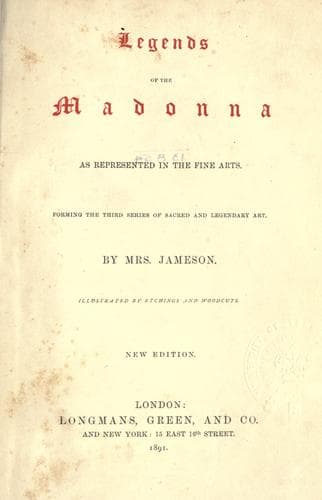
Legends of the Madonna as Represented in the Fine ArtsJameson, Mrs. (Anna)
Religion
Legends of the Madonna as Represented in the Fine Arts
Jameson, Mrs. (Anna)
Christian saints in art; Mary, Blessed Virgin, Saint -- Art; Mary, Blessed Virgin, Saint -- Legends
In a very rich composition by Lucas van Leyden, Herod is seen in the
background, standing in the balcony of his palace, and pointing out
the scene to his attendants.
As we might easily imagine, the ornamental painters of the Venetian
and Flemish schools delighted in this subject, which allowed them full
scope for their gorgeous colouring, and all their scenic and dramatic
power. Here Paul Veronese revelled unreproved in Asiatic magnificence:
here his brocaded robes and jewelled diadems harmonized with his
subject; and his grand, old, bearded, Venetian senators figured,
not unsuitably, as Eastern Kings. Here Rubens lavished his ermine
and crimson draperies, his vases, and ewers, and censers of flaming
gold;--here poured over his canvas the wealth "of Ormuz and of Ind."
Of fifteen pictures of this subject, which he painted at different
times, the finest undoubtedly is that in the Madrid Gallery. Another,
also very fine, is in the collection of the Marquis of Westminster.
In both these, the Virgin, contrary to all former precedent, is
not seated, but _standing_, as she holds up her Child for worship.
Afterwards we find the same position of the Virgin in pictures by
Vandyck, Poussin, and other painters of the seventeenth century. It is
quite an innovation on the old religious arrangement; but in the utter
absence of all religious feeling, the mere arrangement of the figures,
except in an artistic point of view, is of little consequence.
As a scene of oriental pomp, heightened by mysterious shadows and
flashing lights, I know nothing equal to the Rembrandt in the
Queen's Gallery; the procession of attendants seen emerging from the
background through the transparent gloom is quite awful; but in this
miraculous picture, the lovely Virgin Mother is metamorphosed into a
coarse Dutch _vrow_, and the divine Child looks like a changeling imp.
In chapels dedicated to the Nativity or the Epiphany, we frequently
find the journey of the Wise Men painted round the walls. They
are seen mounted on horseback, or on camels, with a long train of
attendants, here ascending a mountain, there crossing a river; here
winding through a defile, there emerging from a forest; while the
miraculous star shines above, pointing out the way. Sometimes we have
the approach of the Wise Men on one side of the chapel, and their
return to their own country on the other. On their homeward journey
they are, in some few instances, embarking in a ship: this occurs in
a fresco by Lorenzo Costa, and in a bas-relief in the cathedral of
Amiens. The allusion is to a curious legend mentioned by Arnobius the
Younger, in his commentary on the Psalms (fifth century). He says,
in reference to the 48th Psalm, that when Herod found that the three
Kings had escaped from him "in ships of Tarsus," in his wrath he
burned all the vessels in the port.
There is a beautiful fresco of the journey of the Magi in the Riccardi
Chapel at Florence, painted by Benozzo Gozzoli for the old Cosmo de'
Medici.
Public-domain text, read in full here on John Shaqi.
Reviews
Reviews
No reviews yet
Be the first to share your thoughts on this work.
Elsewhere in the archive
Join the Discussion
Join the discussion
Sign in to leave a comment or review.
Sign InorCreate an account