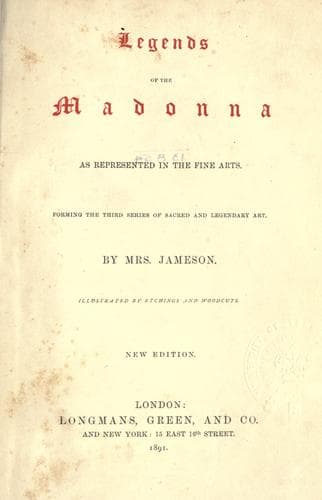
Legends of the Madonna as Represented in the Fine ArtsJameson, Mrs. (Anna)
Religion
Legends of the Madonna as Represented in the Fine Arts
Jameson, Mrs. (Anna)
Christian saints in art; Mary, Blessed Virgin, Saint -- Art; Mary, Blessed Virgin, Saint -- Legends
After the birth of her Son, Mary was careful to fulfil all the
ceremonies of the Mosaic law. As a first-born son, he was to be
redeemed by the offering of five shekels, or a pair of young pigeons
(in memory of the first-born of Egypt). But previously, being born
of the children of Abraham, the infant Christ was submitted to the
sanguinary rite which sealed the covenant of Abraham, and received
the name of JESUS--"that name before which every knee was to bow,
which was to be set above the powers of magic, the mighty rites
of sorcerers, the secrets of Memphis, the drugs of Thessaly, the
silent and mysterious murmurs of the wise Chaldees, and the spells
of Zoroaster; that name which we should engrave on our hearts, and
pronounce with our most harmonious accents, and rest our faith on, and
place our hopes in, and love with the overflowing of charity, joy, and
adoration." (v. Bishop Taylor's Life of Christ.)
The circumcision and the naming of Christ have many times been painted
to express the first of the sorrows of the Virgin, being the first of
the pangs which her Son was to suffer on earth. But the Presentation
in the Temple has been selected with better taste for the same
purpose; and the prophecy of Simeon, "Yea, a sword shall pierce
through thy own soul also," becomes the first of the Seven Sorrows.
It is an undecided point whether the Adoration of the Magi took
place thirteen days, or one year and thirteen days after the birth of
Christ. In a series of subjects artistically arranged, the Epiphany
always precedes, in order of time, that scene in the temple which
is sometimes styled the Purification, sometimes the Presentation and
sometimes the _Nunc Dimitis_. They are three distinct incidents; but,
as far as I can judge, neither the painters themselves, nor those who
have named pictures, have been careful to discriminate between them.
On a careful examination of various compositions, some of special
celebrity, which are styled, in a general way, the Presentation in
the Temple, it will appear, I think, that the idea uppermost in the
painter's mind has been to represent the prophecy of Simeon.
No doubt, in later times, the whole scene, as a subject of art, was
considered in reference chiefly to the Virgin, and the intention was
to express the first of her Seven Sorrows. But in ancient art, and
especially in Greek art, the character of Simeon assumed a singular
significance and importance, which so long as modern art was
influenced by the traditional Byzantine types, modified, in some
degree, the arrangement and sentiment of this favourite subject.
Public-domain text, read in full here on John Shaqi.
Reviews
Reviews
No reviews yet
Be the first to share your thoughts on this work.
Elsewhere in the archive
Join the Discussion
Join the discussion
Sign in to leave a comment or review.
Sign InorCreate an account